10.15.2012

Black Samurai (1977)

PLOT: A secret agent is forced to pursue a dangerous cult after its members kidnap his woman. It’s nice to see a display of such loyalty when he clearly could have done better.

Director: Al Adamson
Writers: B. Readick (screenplay), Marc Olden (novel)
Cast: Jim Kelly, Roberto Contreras, Marilyn Joi, Essie Lin Chia, Biff Yeager, Bill Roy, Charles Grant, Jace Khan


PLOT THICKENER:
While a regular fixture in the horror genre, portrayals of cults have appeared only sporadically in more mainstream and critically-acclaimed films. The backwoods clan of 2011’s Martha Marcy May Marlene haunted arthouse audiences with equal parts trauma and folk music. More recently, Paul Thomas Anderson’s latest film, The Master, examines a cultish group of brainwashers which has nothing whatsoever to do with Scientology. It’s timely, then, that we take a look at another cult-centered film ripe for accolades and deep contemplation. For our contribution to the Mysterious Order of the Skeleton Suit’s October roundtable-- “Satan’s Schools for Ghouls” -- we take a tumble into the zany black magic of 1977’s Black Samurai. This marks the first time we dip into the filmography of Jim Kelly, and the last time I watch Black Samurai.


The character was originally hatched as the central hero in a series of novels by crime writer Marc Olden. For better or worse, this is the one and only film adaptation. I knew none of this until I read Keith’s review over at Teleport City. If you want a comprehensive review of the film, its relationship to the novel on which it was based, and a well-formed critique of Al Adamson’s cinematic legacy, be sure to read it. Especially since we’re probably going to concentrate on punch sound effects and Jim Kelly’s impeccable afro in the review here.

Robert Sand (Kelly) is a martial artist and more important, an elite agent in the international crime-fighting agency, D.R.A.G.O.N. He’s enjoying a sunny vacation when his colleagues show up during a casual game of tennis with a lady friend. “We need you on this case, Sand,” they say. “WTF, I’m on vacation,” Sand responds. He only relents after finding out that his main girl, Toki (Lin Chia), has been kidnapped by the target, a cult leader named Augustus Janicott. Known to his followers as the Warlock, his file indicates that he has a history of heroin possession, mind control, extortion, pornography, and ruffled dress shirts.


As evidenced by transitional footage of an airplane landing, Sand travels to some remote location far enough away that it necessitates air travel. He begins a shadowy descent into the world of the Warlock, where mysterious cars attempt to run him off the road, angry little people break into his hotel room and hold him at gunpoint, and evil, buxom sidekicks are very sensitive to having their sexual propositions declined. Unfortunately, the Warlock and his minions are pure villain filler, and I have no clue what beliefs or objectives to which his supposedly Satanic cult ascribes. They have soirees with mariachi music one night, and blood rituals with African drums, masks, and shoddy pyrotechnics the next. Sand’s superiors allege that he uses his followers for drug trafficking and prostitution, but there’s no evidence of that in the film. In fact, the most harmful and offensive thing about the Warlock is the acting of Bill Roy.


While fairly incompetent when shooting action scenes, Adamson is exceptional at creating three-minute montages of an attractive couple dressed in floral prints kissing softly and strolling through the forest. We’re supposed to care about the relationship between Sand and Toki based on this scene alone, but wordless displays of affection are a lame surrogate for a half-baked romance between underwritten characters with limited on-screen interaction. Would terrorizing the damsel a bit more make the audience more sympathetic to her plight and desirous of her rescue? Possibly, but the worst thing she encounters is a weekend in a locked cell and a probable diet of stale bread and tepid water. In Hollywood, that’s called detox.

For fans of “so bad it’s good” cinema, I might cautiously recommend this film, but would otherwise wave a giant red flag devoured by flames toward anyone looking for an example of solid 1970s action or blaxploitation fare. Sand drives a cool souped-up purple sports car and even zooms around in a jet pack for a good five minutes, but otherwise there's not much here for action fans to chew on. There’s no real gore and outside of a couple impressive jumps from high places, the stunts are lacking.


Instead of liberating Kelly and his fight skills as Robert Clouse did in the terrific Black Belt Jones, Adamson dogs the choreography with poor shooting angles and awful editing. The sound effects are fun and properly exaggerated, but the fights are so short and stilted that none of it matters much. (Most amusing: Kelly shouts “Hello turkeys!” while punching enemies in the cock during a party). Adamson swaps technically proficient for zany, a stylistic choice perhaps best encapsulated by the climactic scuffle between Kelly and a live goddamn vulture. The best (i.e. longest) scene is between Kelly and Charles Grant, known here as Bone, but probably best known as Kim Delaney’s first husband. Bone is positioned as the best physical match for Sand, but our hero relentlessly toys with the henchman during their confrontation by showing off his boxing footwork and taunting him with homophobic slurs before breaking his back.

In a movie loaded with curious technical choices, this was, for me, the most egregious. This particular version of the film was scrubbed entirely of even entry-level curse words, but the production team saw fit to leave all instances of the aforementioned "f-word" slur fully intact for the DVD’s 2001 release. While I understand that the 1970s were a different time for relations between people of differing sexual orientations, I’m not quite sure what the rationale was behind the inclusion. Offensive, sure, but only slightly more puzzling than BCI’s use of the “Vampire Hunters” theme from the original score for Bram Stoker’s Dracula for the DVD’s title menu.


VERDICT:
A few months ago, I predicted that The Dynamite Brothers wouldn’t be my last Adamson film and that prophecy was fulfilled. That wasn’t a particularly good film, nor was this, and I have no reason to believe that the final Kelly-Adamson collaboration, Death Dimension, will somehow reverse the pattern (despite a really cool poster). A handful of zany moments prevent this from being a complete snoozer, but it’s not indicative of Kelly’s talents as a martial artist or screen presence. Unless you’ve exhausted all other options in the “jetpacks in cinema” or “human versus animal fight scene” subgenres, I would keep moving along.

AVAILABILITY:
Amazon, Netflix, EBay.

2 / 7

FURTHER READING:
For more context and critique of this film, head over to our brother-from-another-mother at Teleport City to read Keith’s review of Black Samurai.


Click the demonic but seasonable image above for additional M.O.S.S. contributions to October’s “Satan’s School for Ghouls!”

9.17.2012

Enter the Interview: Loren Avedon


Between romantic melodramas, comedies, and wuxia epics, Hong Kong's booming film industry was producing a couple hundred films per year during the 1980s and early 1990s. However, the region's cinematic bread and butter -- and its most popular genre internationally -- was the action film. Due in part to the transcendent popularity of Bruce Lee and the recent homegrown success of The Karate Kid, the U.S. market was primed for more kicks to its cinematic face.

Seasonal Film Corporation rose to the challenge and produced a total of seven films which combined Hong Kong action direction and fight choreography with American actors, locations, and sensibilities. Perhaps no other action star is as irrevocably linked to this series of films as Loren Avedon, who played the lead roles in No Retreat, No Surrender 2, No Retreat, No Surrender 3: Blood Brothers, and King of the Kickboxers. They remain three of the best American martial arts films ever produced. Armed with tremendous speed and technique during fight scenes, and humor and confidence in his line delivery, Avedon took the ball and ran with it.

Following his work with Seasonal, Avedon acted on television shows such as Baywatch and Martial Law, performed fight choreography for Tiger Claws III, and co-wrote the story for 1998's Deadly Ransom, a film in which he also starred. When I approached him for our very first interview this past August, he was extremely gracious with his time and candid in his responses. We touched upon everything from the ingredients of good fight choreography, to playing the villain, to his respect for co-star Billy Blanks.

Fist of B-List: Within about a week’s time, you went from selling used cars to starring in an action feature (NRNS2). Based on the changes in the industry you’ve observed during your career, would it be easier or more difficult for a twenty-something Loren Avedon to break through in today’s film scene?
Loren: I do have a one in a million story, and I know I am truly lucky to have been in the right place at the right time. But you create your own luck sometimes, when preparation meets opportunity as is in my case. In 2012, with technology allowing anyone with a digital video camera and computer to make their own film, or at least a great demo, the industry has changed completely for an up and comer. However, the fact is that it takes a lot of time, money and people to make a good commercial film for the international market. There is so much competition it depends on what your goals are as the twenty-something aspiring action star. I'd say it’s easier to break through these days because of technology, but at the same time more difficult because others can do the same thing, so it all boils down to talent, desire, timing and hard work.


Fist of B-List: The art of Tae Kwon Do has a major emphasis on kicks. Who -- perhaps other than Hwang Jang Lee -- are some of your favorite kickers to watch on film?
Loren: Of today’s films, I like Tony Jaa, Scott Adkins, and Donnie Yen and of course the great stunt men who you see flying in and getting kicked out, who will never get any credit. Of course, my all-time favorite is the original, the one and only, Bruce Lee.

Fist of B-List: As a martial artist, what do you believe is the most important element in a successful fight scene? The creativity and execution of the choreography? Shooting angles? Editing?
Loren: All are important, but it really depends on your fight director/choreographer and the talent in front of the camera as the key ingredient. If you have excellent athlete/martial artist/stunt actor fighters, you will have a great fight scene, but then again if you don't have a great director of photography, or 2nd unit director that knows how to shoot it, you are screwed. But if the fight is great because of the talent in front of the lens, and enough coverage, the editor can sometimes fix all. What I loved about working with the Chinese is they had the editor on set working with the director, fight choreographer, actors and DP. So the editor knew exactly what the director wanted and was able to suggest some shots to the director, and/or take notes on what takes he liked the best of those that were printed. The editor went to all the dailies -- remember we used to shoot on 35mm film -- to check the shots. If they were no good or something was missing, we'd shoot what was needed. We had no video playback, so a lot of the shots, the fight choreographer and director would put eye to lens themselves when we rolled camera, to make sure the shot was framed the way they wanted it. These days you have so many effects, software, and CG to help make things work, but you have to have all the ingredients and lots of coverage, or you'll end up with rubbish. It’s the little things: the reactions, the power powder, the sound, the acting while fighting…all can make things more powerful. It’s a team effort.

Fist of B-List: You’ve mentioned your fights with Billy Blanks (King of the Kickboxers) and Matthias Hues (NRNS2) as personal favorites. Which fight scene (or scenes) from your film work proved the most difficult for you individually?
Loren: Don't forget the end fight in Blood Brothers with Keith Vitali... that was a killer too. All of them were difficult really. If I wasn't sick from the food, I was sore, bruised, injured and in pain, boiling hot or freezing cold weather, and tired as hell.
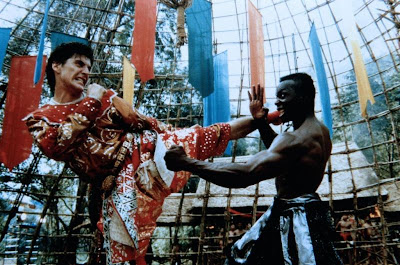
Loren Avedon and Billy Blanks face off in 1991's King of the Kickboxers.
Loren Avedon and Billy Blanks in 1991's KING OF THE KICKBOXERS.

Fist of B-List: Your fight with Billy in KotKB made use of platforms of differing heights surrounded by water, and the climax with Keith, Mark Russo, and Rion Hunter in Blood Brothers involved scaffolding. What were some of the challenges to you as a fighter in engaging with those unique physical environments?
Loren: I'm not a fan of heights, and in KotKB, when I walked the final fight set with the fight choreographer and the director, I noticed that below each platform were real sharpened bamboo sticks. So I said calmly, "can you please make those prop sticks?" Because if anyone -- crew, cast, extras -- happen to slip off the platform, they or I'd be killed. Hellooooooo!

Thank God, I had a great co-star in Billy Blanks, an exceptionally gifted athlete, a gentleman and one of the most humble yet powerful and fast men I have ever known. He/we made it work. I remember him saying to me in the beginning of production, "this is your movie, you're the star and I want to make this film great," and he did. He was one of the best and still is. The challenge for me was keeping up with one of the greatest champions on earth, 7-time world karate champion, Billy Blanks. He made me better, and so did Keith Cooke. I remember we would train together in the hall of the hotel, or in whatever space we could find. When you train with athletes that are more gifted than you are, it makes you better, it bumps up your ability. What you thought you couldn't do, you just do. Then, you get scared and realize what could have happened later and wonder how you did it.

Honestly, the challenges were -- as an athlete, and as a martial artist -- mind over matter, maintaining an even keel, and developing the mental toughness needed to overcome any obstacle. You can't let anything affect your concentration, and covering your ass, that was the challenge, more than as a fighter. The fighting was what I loved. In KotKB, fighting over mosquito and parasite infested klong water with sharpened bamboo pungee sticks below, barefoot, dripping with sweat, 99 degrees with 99 percent humidity, with a mask on, fighting with a sword and then with other apparatus -- took two weeks, six days a week, 12 to 14 hours a day -- let me just say, is truly an example of "what doesn't kill you makes you stronger."
 
In Blood Brothers, with the paint scaffold and again -- 130-degree heat in the summer in Florida, 30 feet off the ground on two 10-inch wide boards that were not secure -- I saw my life flash before my eyes many times. By the third day, I was used to it, and was swinging around like a monkey. The worst thing that happened was when the cameraman 30 feet above me shooting down dropped a metal focus puller, and it hit me in the solar plexus and knocked the wind out of me. After all that, at least he didn't drop the camera on me, that would have left a mark. All good stuff, and no whining allowed. [laughs]

Loren Avedon and Greg Douglass have a mild disagreement in 1992's FIGHTING SPIRIT.

Fist of B-List: Can personal or professional tension with a co-star enhance a fight scene, or hinder your ability to work on it together effectively?
Loren: Tension or disagreements on set with a co-star makes things much harder for everybody on the film to work together effectively. Attitude spreads, if you're already in a miserable situation because of the conditions and you have an actor whining, or anyone for that matter, it affects everyone. We all have our bad days, but when you're part of a team you act professionally and have respect for the job you are doing. You cannot let anything distract you. We are all human, but when the cameras roll, it’s all business. Also, people remember a person’s attitude under stress, and they will talk. So, if you want to work, you put your issues aside and do the job well, because at the end of the day it’s you up there on screen forever for all to see and the camera doesn't lie.

Fist of B-List: Speaking specifically to action filmmaking, how does the American film set compare to those you’ve encountered internationally?
Loren: Well, it’s the conditions, crew, cast and budget usually that are the difference. Most films are cast in the U.S. and go abroad. When you're working under S.A.G. rules you have more amenities and of course protection. Overseas or out of the U.S., you can be worked harder, in less than optimum conditions, with less safety provisions, so you have to "cover your ass" and make sure that you vet all the people and things that can affect your well-being, safety, comfort, and ability to do the best job you can. Out of the U.S., I've had to put my foot down many times because of safety issues, not being paid on time, etc., but by the same token, sometimes you are able to do more things that would be a no-no on a set in the U.S.

Fist of B-List: It seems like starring in a Filipino film was something of a right of passage for American action actors, from Leo Fong to Karen Shepard and Jerry Trimble. Fighting Spirit is one of your lesser known films, yet contains a number of excellent fight scenes. How did you get involved with that production and what was that experience like?
Loren: That was fun, and we did it all with little or no budget, choreographed on the fly. When I got there, we re-wrote the script (I had never even read the script) and made more sense of it. The stunt coordinator that also did the choreography was one of Jackie Chan’s team and we got on well. The Philippines has some great talent and English is spoken by almost everyone, so it makes it easier to work. I was offered that role through my buddy Jacob Bressler in L.A., the producer wanted me to be the star, so we made a deal over coffee at the Sunset Hyatt and a week later I was on a plane to PI.

Fist of B-List: For the most part, you’ve been cast as the hero but have also played the villain in films like Operation Golden Phoenix and Tiger Claws III. Which is more fun for you as an actor?
Loren: Both are fun, but playing the villain gives you so much more room to be creative. As we have seen, good guys have been getting more and more close to the bad guys in what is OK. The difference is, of course, the hero has a moral code and cannot cross certain lines. What makes it fun to play a great villain is the freedom to create a moral code and choices that belong to that character specifically. A great villain doesn't think he is doing anything wrong at all, he believes he has the right to do whatever he wants for whatever reason. For an actor that is heaven.

Fist of B-List: Which has been your favorite character to play?
Loren: My favorite good guy character was Frank Stevens in The Silent Force, and my favorite bad guy character was playing Stryker Goodenough in Tiger Claws III. That was a blast.

Loren Avedon as Frank Stevens in 1998's THE SILENT FORCE.

Fist of B-List: You did a guest spot for In Living Color in 1991 and performed in a scene with Damon Wayans. Your King of the Kickboxers co-star Billy Blanks had a small but memorable part in The Last Boy Scout, also starring Wayans. Were these two castings related in any way or just a happy coincidence?
Loren: My part in In Living Color came after King as did Billy's part in Last Boy Scout. Purely coincidence.

Fist of B-List: Of the action stars during your peak era, with whom would you have liked to work, but never had the chance to?
Loren: I would have like to work more with the Chinese -- with Sammo Hung, Jackie Chan, Michelle Yeoh -- and in Hollywood with some of my idols like Clint Eastwood, for example.

Fist of B-List: Were there any Western martial arts actors with whom you would have liked to work? (ex. Jeff Wincott, Gary Daniels, Richard Norton, Mark Dacascos, etc.)
Loren: All you have mentioned I would have loved to work with. Jeff is by far the best actor of all of us. [laughs]

Fist of B-List: Either in your martial arts training or as a result of a gaffe during the filming of a fight scene: who's the hardest hitter/kicker you've ever encountered?
Loren: Can't really say, but in training it would be JJ Perry. On film, Billy Blanks -- I saw stars a few times when he kicked me. Funny, the most painful kick was the one in KotKB where he drop/axe kicks me in the back, and he hit the lung point between the shoulder blade and spine -- no padding -- and I saw stars and couldn't breathe, but I finished the shot. When the director yelled “cut,” I had to sit down for a few minutes right there on the spot. Billy was concerned and I said to him, "don't hold back,” and he said "but, I am," and we laughed. I said, "well, then keep holding back, but let me have it." He laughed and we carried on. I have so much respect for Billy, he kept our movie poster in his dojo for years. I wonder if it’s still there somewhere in his place in Agoura [California]. I haven't spoken to him in years, but I can tell you that if I did see Billy, he would stop what he was doing, come over and we would shake hands, bro hug and smile. I remember one time coming by his school in Sherman Oaks and I had just missed him, and he ran down to the parking lot to catch me so he could say hello. He's a bad ass, but he has a lot of class, he is a man of honor, and a true martial artist. As my mother taught me, "only the truly great are humble," and she is right.

Loren Avedon and David Michael Sterling in 1990's NO RETREAT, NO SURRENDER 3.

Fist of B-List: American martial arts films from the 1980s and 1990s are known somewhat for the predominance of Otomix gear and Zubaz pants. What's been your most regrettable wardrobe choice from your films? Does anything stand out that made your fight scenes particularly uncomfortable to perform?
Loren: Mitch Bobrow of Otomix always gave me swag to wear, and in the 80's that was the bomb, and those baggy Otomix pants... much easier to move.

Those costumes in KotKB were tough. We had to be sewn into them practically every day. Wearing the light green striped polo shirt, with green pants in NRNS3 going into the karate school was interesting. I think I went to the director and asked him if Will [Avedon’s character] “had a feminine side" with the wardrobe choices they made. If you notice, I always tried to wear long sleeved shirts and pants, so I could wear pads. Then wearing pads constantly was nasty because every day they'd be soaked dirty and bloody, so I'd air 'em out at night and get ready for the next day. I remember asking wardrobe to sew in a diamond shape piece of extra denim in the crotch of the jeans that I did the split kick with in the bar in NRNS3, because I couldn't do the split with standard jeans. If you notice on your gi pants, in the crotch area, is a diamond shaped piece of material. That's what allows you to kick without nutting yourself every time.

Funny anecdote about Mitch Bobrow at Otomix: he would always say that he beat "Superfoot" Bill Wallace back in the point fighting tourney days, and he had some pics of him and Bill in action that he showed me. When I would see Bill and say "you know, Mitch says he beat you back in the day at the internationals," Bill would say to me: "tell Mitch, I don't recall him beating me, and you tell Mitch any time he wants to refresh his memory, he can lace up his gloves and we can go round and round." If you've ever met Bill, who, by the way used to use me as his demo dummy at class -- he'd comb my hair in front of the whole advanced class, with his toes, to demo his famous hook kick and of course, his balance and strength, then, of course, his body jab side kick just above the belt, et al., fun stuff -- and seen those wild eyes, yikes. I used to make him chase me around the mat with his bad knee, cause I was younger and faster, and tag him with little stuff, and pray. Then, usually he'd cut me off and light me up with that jab, right hand and left hook to the head or body, and as a finisher slide up and try and stick his heel through my head! Thank heaven, as I said, I was younger and faster than him (at that time, he was 45, I was 20). Lucky for me!


Fist of B-List: Much appreciated, Loren! Take care.
Loren: A pleasure.

***
I'd like to thank Loren again for his time, and encourage readers and fans who want to hear more of his thoughts on the film industry and his career to check out the audio interviews below:

With The Gentlemen's Guide to Midnite Cinema & Karl Brezdin at ggtmc.libsyn.com
With Super Marcey and John Hamilton at supermarcey.com.


9.10.2012

One Man Army (1994)

PLOT: A martial arts instructor returns to his hometown after the death of his grandfather only to find that corruption has taken root. Will he dispense vigilante justice and let the heads roll, or run for public office and get a shiny sheriff’s badge?

Director: Cirio H. Santiago
Writer: Daryl Haney
Cast: Jerry Trimble, Rick Dean, Melissa Moore, Dennis Hayden, Paul Holmes, Yvonne Michelle, Nick Nicholson, Jim Moss, Ned Hourani


PLOT THICKENER:
Before 1973’s Walking Tall was remade into a middling action vehicle for Dwayne Johnson in 2004, its premise had already been ground into dust by knockoffs and mimicry. 1980’s Defiance borrowed a bit from the Joe Don Baker classic and Robert Clouse cribbed from it rather liberally for 1990’s China O’Brien. Not to be outdone by some rinky-dink outfit like Golden Harvest Company, Filipino action auteur Cirio H. Santiago went back to the same well to make 1994’s One Man Army. He trades one blonde for another by reuniting with Jerry Trimble, and that’s not Jerry Trimble of Jerry Trimble Helicopters, but rather Jerry Trimble, the PKC WORLD KICKBOXING CHAMPION. Sorry for the all-caps text, but the box art and opening title sequence really got into my head.

Trimble plays Jerry Pelt, a martial arts instructor who receives a phone call so urgent that he takes it on the red phone in the dojo’s inner office. The news is terrible: Grandpa Pelt, the man who raised him, is dead. Continuing in the proud tradition of martial arts teachers driving total shitboxes, he packs up his rusty Volkswagen Bug and departs for his hometown. As soon as he crosses the county line, a group of boozehounds in a pickup truck run him off the road, damaging his car. He rectifies the situation only a few minutes later in the greatest gas station action sequence since The Jerk, and we’re off to the races.


Upon arrival to the sad and poorly attended funeral, he’s greeted by an old flame: high-powered attorney Natalie Pierce (Moore). Against the backdrop of this misery, though, Jerry re-establishes some old connections. He and Natalie share some dessert that night, his grandfather’s German Shepherd, Hank, is still barking up a storm, and old friend and local roughneck Eddie Taylor (Hayden) arrives with an invitation to catch up over a few rounds of brew.

During his night out on the town, Jerry discovers that things aren’t the way they used to be. He and Eddie arrive at the local watering hole to find it overrun with topless prostitutes cavorting with clients out in the open. In the bar’s backroom, bets are placed on unsanctioned full-contact fights. How did things get this bad? Not without a certain local sheriff named Pat Boze (Dean) turning a blind eye and a crime boss named Sharperson (Holmes) giving him a cut of the profits.


After a string of suspicious incidents involving arson, assaults, and human trafficking tunnels, Jerry decides to run against Boze for sheriff and clean up the town for good. With Natalie’s legal expertise, Hank’s knack for biting and disarming potential gunmen, and Jerry’s ability to rally crowds during montages with patriotic music, the campaign is well-equipped for the political meat grinder. It won’t be easy, though. Sharperson’s influence runs deep, and Boze and his crew are coked out of their minds with easy access to firearms.

While the plot points are tired and silly at times, I ended up enjoying One Man Army quite a bit. The film’s pace sucked me in immediately and the solid cast kept me engaged. Similar to Live by the Fist, this checks in under 80 minutes and Santiago wastes no time in establishing his hero with the gas station fracas around the five-minute mark. With his laid-back manner and easygoing delivery  -- he hails from Kentucky -- Trimble is a good fit as the righteous local hero. Character actor Dennis Heyward was cast perfectly as Jerry’s grizzled friend, and B-film veteran Dean is both intense and menacing as Pat Boze.


No stranger to the action genre -- she was the unfortunate victim of a bacon grease torture by Robert Z’Dar in Samurai Cop -- Melissa Moore is pretty solid, sharing most of her screen time with Trimble. While I’m not going to complain much about topless scenes, 66% of her nude scenes are completely (and hilariously) out of context. For instance, during a conversation about the sheriff’s race during a windy and overcast picnic, Natalie suddenly strips down and goes skinny-dipping to test Jerry’s courage. When he follows suit and jumps in, we know we’re dealing with a bad-ass motherfucker. He didn’t even wait for a full hour after lunch before swimming.

In Live by the Fist, Santiago did well to match Trimble up with a few legitimate martial artists at the back end of the film, escrima practitioner Roland Dantes among them. Dantes is absent from this production, and unfortunately there was no one to really take his place in what should have been the best stretch of fight scenes in the film. I spotted who I believe was an uncredited Ned Hourani fighting Trimble on a rooftop but the fight lasts under a minute, and no one else in the story is built up as a physical threat to Trimble’s character. This was a missed opportunity, because Hourani can hold his own during extended fight sequences, as evidenced by his work in Blood Hands and Fighting Spirit. The choreography is cookie cutter, but Trimble lives up to his reputation as one of the best kickers of his sport and the stuntmen sell pretty well.


VERDICT:
If you enjoyed Live by the Fist, this is another enjoyable Filipino action romp from the same actor and director duo. The amount of heroic dog scenes with the German Shepherd are on par with the Benji and Rin Tin Tin franchises, so this might be something you can watch with the nieces and nephews. Just be sure that you get them to sign affidavits forbidding them from telling their parents about the voluminous amounts of cocaine use, boobs, gunfire, and kickboxing they’ll see in the rest of the film.

4 / 7

9.01.2012

Hollywood Cop on the Gentlemen's Blog


In between grilling dead animals and shotgunning cheap beers during this last unofficial weekend of the summer, take a few minutes to check out a review of the 1987 cult action film Hollywood Cop over on The Gentlemen's Blog to Midnite Cinema. If you like movies where the villains are killed in ascending order of their importance to the story, you'll probably dig it.

And where would any 80s action movie be without ninjas? Up shit’s creek without a shuriken, that’s where. And yet, this is precisely where Hollywood Cop finds itself. While the baddies count a half-dozen martial artists among their ranks, ninja costumes just weren’t in the budget so they had to settle for street clothes. This is only one of several missteps in Iranian director Amir Shervan's American debut. Be sure to check out the film.


2-MINUTE (OR SO) HOLLYWOOD COP! from Everything Is Terrible! on Vimeo.

8.14.2012

Superfights (1995)

PLOT: After the local news media airs footage of his fight with a group of thugs, a young martial arts enthusiast uses his new fame to join Super Fights, a popular fighting organization. What a self-serving dick.

Director: Siu-Hung Leung
Writer: Keith W. Strandberg
Cast: Brandon Gaines, Keith Vitali, Kelly Gallant, Chuck Jeffreys, Cliff Lenderman, Patrick Lung-Kong, Brian Ruth, Feihong Yu, Jim Steele, Rob Van Dam


PLOT THICKENER: 
In terms of future careers, kids have a tendency to dream big. Many aspire to grow up and enter practical fields like medicine or education, while others dream of odd or completely unrealistic jobs: penguin milker or mermaid supermodel. The protagonist in 1995's Superfights falls into the latter group. Probably with a much louder thud than the other kids, because he’s roughly 20 years old.

By day, young Jack Cody (Gaines) works a boring job as a clerk in a sporting goods warehouse.  By night, he’s a lifelong fan of a fighting organization called Super Fights. The competition could best be described as the love child conceived during a drunken night of fun between WMAC Masters and pro wrestling. The fighters have colorful costumes and unique personalities. The live events feature martial arts battles between heroes and villains in front of packed crowds. Jack is so enthralled with the sport that he spends the majority of his work hours going through training drills with an elaborate system of pulleys and mannequins. This is not so unusual. When I worked at American Apparel, I rigged up a similar system to simulate heated confrontations with people in overpriced v-neck shirts who had nothing interesting to say.


During a contemplative night drive, Jack notices a girl being mugged at an outdoor ATM and makes the save. Sally Wong (Yu) is only the latest in a long line of young women who failed to avoid using the cash machine at night in a poorly lit area. (They're called "best practices" for a reason, Sally). The resulting media blitz piques the interest of Super Fights president Robert Sawyer (Vitali) and he sees dollar signs. Not because he’s on LSD, but because the young media hero represents a great business opportunity.

Sawyer extends Jack a lucrative offer -- an American flag-themed costume and a roomy townhouse -- and the one-time superfan joins the ranks of his idols as a competitor. He finds himself brushing shoulders with guys like No Mercy Budokai (Lenderman) and Dark Cloud (Jeffreys) in the locker room and the gym. He hones his skills in a high-tech training center under the tutelage of Sawyer's right-hand lady, Angel (Gallant), herself an active Superfighter. Throughout the film, you can cut the sexual tension between Jack and Angel with a knife, because the sexual tension is room temperature and easily spreadable on bread. Kelly Gallant side-boob has that effect on things.


To balance out the friskiness of this mentor-student relationship, Jack occasionally trains with Sally's grandfather (Lung-Kong). A Tai Chi master, Grandpa Wong doesn't think much of Jack's fighting skills, his new gig as a famous fighter, or even his townhouse. The elder is right to be suspicious because things in the world of Super Fights are not as they appear. The fighting roster is encouraged to gargle down an odd vitamin cocktail and selected fighters regularly cruise around in a white van and leave a trail of destroyed restaurants and crippled drug dealers in their wake. What are they up to? Why doesn't Jack close the deal with Angel or Sally? Why did the filmmakers dress up Chuck Jeffreys like a Jamaican Jack Sparrow?

As stated in the past, the real sweet spot for American DTV martial arts movies is that holy intersection of a zany premise, good fight sequences, and hilariously bad acting. The latter element here, while hammy, isn't consistently awful enough to be funny, but the premise, characters, and fantastic fight sequences in Superfights make this a delicious slice of action cheese. In his American directorial debut, Siu-Hung Leung took a bit of a risk by relying on a first-time actor in Brandon Gaines to carry the film, but Gaines hits most of his character’s notes to perfection. He's enthusiastic to the point of obnoxiousness and naive to the point of stupidity, which makes the journey into his passion's sleazy underbelly all the more compelling. Or ridiculous.


Given his easygoing demeanor and a serious lack of vocal gravel, one could argue that Keith Vitali was a poor casting choice for the Robert Sawyer character. However, I’d make the case that these traits, in some ways, enhance his Sawyer’s veneer of warmth and generosity. Such a personality guise made Gaines’ buy-in all the more plausible. Furthermore, his fight scene at the back-end of the film is one of the better scenes you're likely to find in Stateside martial arts output. It’s shot competently, the choreographers make good use of the physical environment, and the performers move with that elusive mix of speed and fluidity.


The film’s appropriately titled theme song, “Superfighter” is an inventive exercise in lyricism. Most action film songs would be content to pair thematically relevant cliches with a few killer guitar licks. Instead, the song “Superfighter” makes direct references to training techniques, the deceptions at the story’s center, and even specific character names. It is both endearing in its absurdity and completely awesome in its literalism. Yes, of course you can find it on YouTube with subtitles.


VERDICT:
For fans of both the martial arts genre and offbeat action, Superfights represents the colored, overlapping portion of the Venn Diagram. There are certainly better uses of your time than creating logical visualizations of related film genre concepts, but I just spent three hours writing a rundown of a chopsocky/wrestling movie. I’m not here to judge. If you like your plots zany, your characters bizarre, and your martial arts fast and technically proficient, Superfights fills all three of your needs. Also, side-boob.

6.5 / 7
Related Posts Plugin for WordPress, Blogger...