Showing posts with label Loren Avedon. Show all posts

6.12.2017

Manhattan Chase (2000)

PLOT: A former hitman for a drug gang is recently released from prison, and must put his life together, raise his estranged son, and help a victim of drug violence evade his former cohorts. Can he find an apartment in the Five Boroughs for less than $1200 a month so he has decent place to sleep in between all this stuff?

Director: Godfrey Ho
Writer: Lisa Cory
Cast: Loren Avedon, Cynthia Rothrock, Steve Tartalia, Nicol Zanzarella, Roberto Gutierrez, Robin Berry, Ron Van Clief


PLOT THICKENER

As many New York City visitors can attest, walking its streets can feel like walking through the set of a movie. From Juice and West Side Story to Mean Streets and Annie Hall, some of the greatest films in the history of cinema were filmed in New York City, the biggest city in the world (if you ignore the rest of the world). Countless critics have astutely pointed out that the Big Apple itself often serves as a character in the films in which it appears, and in no film is that more apparent than 2000’s Manhattan Chase, where NYC plays an innocent urban landscape terrorized by a low budget Godfrey Ho film production.

Loren Avedon plays Jason Reed, a former drug gang hitman who gets released from prison after serving a six-year sentence for attempted murder. He’s not about that life anymore, though, and he attempts to leave behind his checkered past so he can raise his estranged son, Tommy (Berry). But only *after* having his former gang cohort, Keith (Tartalia), give him a lift home from prison. Because who’s keeping track, amirite? Keith mocks Jason for his likely employment options with his criminal record (e.g., K-Mart), and his continued refusal to return to the gang fold. Part of raising his son will require some semblance of financial stability, and in that regard, Jason is entering an uncertain future rife with risk (and either a bike messenger gig or dressing up as a knock-off Batman in Times Square).


Jason’s attempted reconciliation with Tommy is strained, at best (as is the dramatic scene that depicts it). Despite his private wishes to have his father in his life -- which the audience learns from his telepathic monologue with the wish-granting sea gulls of Coney Island -- Tommy offers only a cold shoulder upon his dad’s return. Had Jason simply noted the current year, he could have avoided at least one major misstep. Gifting your child with a decade-old handheld gaming device like the original Gameboy is not usually the best method to getting back into the good graces of a surly kid. Just last year I got my 11-year-old cousin a game for the PS3 and he tried to gut me with a cake cutter. Kids grow up so fast!


As fate would have it, circumstances beyond Jason’s control add another roadblock to his attempt at responsible parenting. After her wicked stepfather’s stash of heroin goes missing, Jennifer (Zanzarella) escapes her home after the rest of her family is gunned down in a brutal drug-killing led by Keith. During her desperate sprint from the killers -- they want their drugs back, naturally -- she ends up on the hood of Jason’s moving vehicle (!) and is driven to safety. Jason is hesitant to help her after that point, but Tommy convinces him otherwise, and they find refuge at the apartment of Victor (Gutierrez), Jason’s old prison buddy. Let’s recap: ex-convicts, the lone survivor of a drug hit, a gang in hot pursuit, and an 11-year-old? This should end fine.

To complicate matters, Jason’s ex and Tommy’s mother, Brenda (Sweeney), is back in town after sobering up in California. After running into her cop sister, Nancy (Rothrock), during a purse snatching (don’t ask) we get a huge lunch-time exposition scene with all of the gory details. Did I mention that Nancy was the cop who arrested Jason during an attempted hit six years ago and put him in prison? I didn’t? I must have been distracted by all of these shiny, wild coincidences!


Following Undefeatable and Honor and Glory, Manhattan Chase was the third and final film in an unofficial trilogy of late-cycle Godfrey Ho films that were: a) filmed in the U.S.; b) featured mostly American casts; and c) strangely coherent with no traces of Ho’s trademark cut-and-paste technique. Of the three, this might be the most violent and nihilistic among them, and given that Undefeatable featured a serial-killing kung fu rapist, that’s saying something. The drug violence throughout the movie is quite grisly, and the climax contains a character death that may legitimately surprise viewers.

All that said, the film suffers from the absence of a colorful and equally unlikable main heavy. Tartalia as the gang lackey, Keith, is the closest thing to a real villain, and he has the necessary fighting chops to gel with both Avedon and Rothrock (though he only fights with the former). However, the character lacks the over-the-top qualities of Stingray from Undefeatable, the pompous presence of Jason Slade from Honor and Glory, and the sustained screen-time and narrative focus of either character. Tartalia made a career playing the evil gwailo, so I’m not totally sure why he didn’t get top baddie billing here. He does have a protracted and curiously graphic and out-of-place sex scene, though, so maybe it was in his contract?


The fights are actually pretty good -- quickly paced with good striking and blocking combinations -- and it’s always cool to see Hong Kong action choreography to go along with some familiar American faces with experience. Avedon runs with that ball for most of the film, and Rothrock’s fight scenes are unfortunately minimal. The pair of NRNS2 alumni is kept largely separated for the majority of the film, which feels like a major missed opportunity (though not as egregious as Ron Van Clief’s 120-second appearance as a mini-van kidnapper).

VERDICT

Manhattan Chase is not a “good” movie in the traditional sense, but I think there’s enough happening here to keep you -- rabid and unpretentious b-movie chopsocky fan -- engaged throughout the run-time: upbeat fight scenes, quirky dialogue, a sincere Loren Avedon performance, and enough squibs to fill a bucket typically used to hold acorns. It’s a shockingly coherent capstone to a unique filmmaking career.

AVAILABILITY

Streaming on Amazon Prime.,YouTube.

3 / 7

3.24.2016

Virtual Combat (1995)


PLOT: In the future, a scientific breakthrough leads to a breakdown in the barrier between virtual reality and the physical world, where computer programs are equipped with human bodies and run amok. What science has wrought, only kicks, guns, and double-stomps to the chest can destroy.

Director: Andrew Stevens
Writer: William C. Martell
Cast: Don “The Dragon” Wilson, Athena Massey, Michael Bernardo, Dawn Ann Billings, Michael Dorn, Loren Avedon, Ken McLeod, Ron Barker


PLOT THICKENER

When direct-to-video martial arts filmmakers started experimenting with science fiction elements during the late 1980s and early 90s, more often than not, the results were, as the French say, “le merde crachin.” With Jean-Claude Van Damme finding success in movies like Universal Soldier and Timecop, the blueprint for the DTV crowd was set, and the smaller studios played mix-and-match with elements from big-budget futuristic productions in which they could let their various martial artist stars run wild. When the dust settled, there were a number of cinematic ambassadors for the sub-subgenre: Olivier Gruner (Nemesis, Automatic); Richard Norton (Hyper Space, Equalizer 2000); and Don “The Dragon” Wilson (Future Kick, Cyber Tracker). I almost feel like I’ve written this exact paragraph before -- is this current Brezdin returning from the past with old copy? Or is it old Brezdin traveling from the past and writing a post while current Brezdin is away on vacation? And why am I suddenly getting a nosebleed? Trying to make your fiction all sciencey just screws things up, and Don the Dragon knows from experience.


In the future, credits have replaced currency. Los Angeles crime has been supplanted by Los Angeles pacifism. And fighting and screwing has largely been replaced by strapping yourself into a giant gyroscope (i.e., aerotrim) and experiencing it inside a virtual reality (VR) program under the supervision of some keyboard jockey. David Quarry (Wilson) and his partner John (McLeod) are members of the grid runners, a security force tasked with defending the “grid” between Los Angeles and Las Vegas from threats both virtual and physical. When a scientist has a major breakthrough in cyberplastic theory, a local evil corporation stands to profit. What they didn’t count on, however, is that the same computer process that can create physical manifestations from cybersex characters, can also be used to bring virtual killers from the “Lethal Combat” fight simulator into the physical world. When a glitch in the system does exactly that, and an elite but egomaniacal fighter named Dante (Bernardo) is set loose in the physical world, the line between virtual and tangible may be forever erased.


Just like the cyberplastic goo in which the virtual reality characters come to life, this film was a warm and slippery mess that’s toxic to pets and small children. A lot of the plot elements and visual gags are straight rips from better science-fiction films like Demolition Man, Virtuosity, and T2: Judgment Day. However, I loved how shameless the filmmakers were about this pilfering and the  world-building that resulted from it. The movie portends the proliferation of the voice-commanded, personalized mobile assistant that retrieves any information you could want (here, it’s called “Mary”). It has programmable sex cyborgs, cyberterrorism, and virtual reality gaming. Looking around now at the emergence of technologies like Oculus, Siri, and Echo, I’m shocked at how much our world is beginning to resemble the one depicted in a friggin’ Don the Dragon Wilson movie. Will buzz cuts and pomade be outlawed in the future? Because for reasons unknown, the hair in this movie is huge and unkempt. Bernardo has always rocked the long locks, but Wilson, McLeod, and Avedon are all rocking some shaggy cuts in a production that had plenty of humidity but clearly lacked an on-set barber or even a single brush or comb.


This film came at an odd point in Loren Avedon’s filmography, one that we might objectively call a downturn in activity. Virtual Combat was sandwiched between 1994’s Operation Golden Phoenix, where he played bad guy Ivan Jones, and 1996’s Safety Zone, an obscure Canadian film that appears to have been released in Greece but nowhere else. While we might point to his role in Operation… as igniting a trend towards playing villains, a closer examination reveals that his turn as Michael Branson, the dickish kickboxer in the 1993’s Baywatch episode, “Kicks,” was the starting point. Avedon has spoken of his fondness for playing villains because they can act without rules, but his character of Parness is more of a corporate underling who lacks any real autonomy. It was also tough to see Avedon’s personality shine through here; he has a natural cockiness that I’ve always found enjoyable in his heroic roles, so it’d make sense to turn that trait up to 11 as a villain. Yet, Parness lacks any clear personality traits or motivations beyond those instilled by his employers. Overall, I felt let down with how he was used in this film, but thankfully, Avedon has a couple of scenes with Wilson and we get a solid fight between the two towards the climax.

On the whole, the action in the film is that solid brand of chopsocky one would expect in a film where Art Camacho is listed as the fight choreographer. That said, I’m not sure he got the most out of the talent here -- the fight between Wilson and Avedon is good, but given their styles I would have expected something with better pace and more wide angles -- the filmmakers relied way too much on close shots and it robs the audience of any sense of movement. Bernardo is a talented guy but I didn’t really see the Dante character as head-and-shoulders above everyone else in terms of skill -- he wields some limb-regeneration trickery straight from the T-1000 toolkit -- but if we’re to believe that he’s a VR program capable of learning the tendencies of its opponents, he needed to seem more invincible and adaptable. (And how David throws a glitch in the Dante matrix is head-scratching). All that said, this film gave me Loren Avedon firing laser beams and a good amount of kicking, so I can’t complain much about the action.


Now for my biggest issue with the film. Virtual Combat employs that weird trope of having Actor A (strong voice) perform all of the dialgoue for Actor B (weak voice) but instead of having Actor A move his mouth and then dubbing him in post-production, the filmmaker uses Michael Dorn’s disembodied voice-of-God dialogue over shots of Bernardo contorting his face to look like he’s thinking out loud. We love Dorn -- he has a great voice, he played Worf, he flies jets. And if you remember Shootfighter: Fight to the Death -- and let’s be honest, who doesn’t? -- Bernardo wasn’t exactly Isaac Hayes in the vocal talent department. On the contrary, he falls into that camp of screen fighters who unfortunately lack the ability to project effectively, doomed to “nice guy” supporting parts because they still sound like teenagers when they open their mouths. Teenagers who haven’t tasted whiskey or smoked a cigarette. Has Jeff Wincott ever been dubbed? Nope, and there's a reason for that. (Wincott Chainsmoking Method wins again). Anyways, this Dorn cover-up makes practical sense and the technique works on paper because it’s a futuristic science-fiction film where we can buy the idea of Dante’s telepathic outbursts. In execution, though, it comes off as overly goofy because the other “dimensionalized” VR clones talk with their own mouths and their own voices, and for some strange reason, the filmmakers included Bernardo’s natural grunts and groans during the fight scenes. The inconsistency undermines the approach, but I look forward to creating a series of supercuts where I dub Dante with dialogue from Skeletor, Zod from Superman II, and Ursula from The Little Mermaid. I might not be joking.

VERDICT

The VR fight simulation angle is interesting, if overly coincidental, given that Expect No Mercy came out the same year, but the intermingling of the tangible and the virtual is what makes Virtual Combat the slightly more novel of the two. This may be the closest that DTV chopsocky ever got to touching upon David Cronenberg’s recurring theme of technology merging with the human body, and it certainly reinforced the notion that he executes that theme better than almost any other filmmaker. I would have liked to see a better use of the supporting cast, but I always get a kick out of seeing what 90s films thought the technological world might look like in only a few decades’ time.

AVAILABILITY

A bit hard to find. VHS is your best bet.

3.5 / 7

1.13.2015

Furious (1984)

PLOT: A grieving martial artist does battle with a group of wizards and new-wave music enthusiasts for control of the universe. All participants are paid in delicious fried chicken for their efforts.

Directors: Tim Everitt, Tom Sartori
Writers: Tim Everitt, Tom Sartori
Cast: Simon Rhee, Philip Rhee, Arlene Montano, Howard Jackson, Mika Elkan, Loren Avedon, Peter Malota


PLOT THICKENER
Jodorowsky. Buñuel. Lynch. “All psychomagical hypnotist meditators and coffee drinkers?” you ask. Close, but no! They’re filmmakers responsible for some of the most transgressive surrealist works in cinema history. Based on his work in 1984’s Furious, Tim Everitt may have had an eye on adding his name to this list. His debut feature film lacks the epistemological heft of Holy Mountain or the fever-dream duality of Mulholland Drive, but make no mistake: Everitt was not afraid to feed your head with the weirdly random thunder. He’ll give you five straight minutes of old women eating chicken while a man in a kabuki mask performs magic tricks for a baby and a shirtless man twirls swords around in the back of a dimly-lit restaurant. And you’ll like it.

After a warrior named Kim (Montano) is chased into the mountains by white dudes in Mongol warrior garb making melodic nature calls lifted from Doug McKenzie, a brief skirmish leads to tragedy. The hooligans seek a powerful navigational tusk (think of a saber-tooth with GPS) that may or may not point the way to the so-called Astral Plane, and Kim was simply caught holding it at the wrong time. To her credit, Kim doesn’t make the theft easy for them, fighting off one fighter with a staff and hitting another in the lower-lumbar / upper-ass area with his own throwing star. Pretty demoralizing, though not as bad as actually dying.


Kim’s martial artist brother, Simon (Simon Rhee), lives in an isolated woodland cabin, teaches martial arts to an eager group of adolescents, and even has a dog. All in all, life is good. When he learns of his sister’s demise, everything goes to hell. He immediately beats the shit out of an outdoor heavy bag in front of his confused students and then storms off to seek guidance from his master, Chan (Phillip Rhee). The older, wiser Chan lives and works in an office building and oversees a dojo, but spends most of his time meditating while floating three feet off the ground or learning new sleight-of-hand magic tricks from his right-hand dude, Mika (Elkan). Noting his protege’s grief, he gifts him with a mysterious pendant and some philosophical claptrap before sending him off on a wild goose chase for spiritual enlightenment. This is odd, because the office building is filled with chickens. You following so far?


Good, I’m glad that’s out of the way. Now, take everything I just told you about the plot of this film and throw it in the garbage along with the leftover macaroni-and-cheese you forgot to refrigerate overnight. Some of this stuff definitely happened, but it’s a patchwork story interspersed with fight scenes and in-camera effects. Watch, rinse, and repeat, because you’ll (arguably) benefit from a few viewings and come up with all sorts of theories. That said, anyone approaching this film and hoping for modern-day, inventive TKD action will come away disappointed. The fight scenes, while good for a 1984 American movie, seem a little loose and under-rehearsed, no doubt a consequence of a micro-budget and rushed shooting schedule. Where the fights succeed is in their energy, frequency, and pure silliness. Enemies throw cardboard boxes from rooftops, restaurant combatants throw bowls of rice at each other, and fireballs turn into chickens mid-flight. Who cares if you don’t get crisp choreography with intricate combinations and epic build-up? This has Simon Rhee fighting a goddamn papier-mâché dragon with a skeleton clenched in its teeth.


Last summer, I was a guest on the GGTMC podcast where we reviewed this film, and while we had a ball discussing the zany elements of Furious, we found it was a slippery movie to discuss given its disjointed story and lack of dialogue. For fans of the genre who are tired of needlessly talky movies filled with exposition, you’re in for a treat. The first line of dialogue -- “All right...” -- comes around the 12-minute mark. Now, the dialogue may not be as sparse as say, Castaway or All is Lost, but even for a 73-minute film, there’s not a whole lot of conversation here to move the plot forward. Everitt instead uses a lot of surreal visuals with uncomfortably long stretches of silence to build the story’s framework, and leaves the audience to fill in the rest. Somehow, for this type of film, it works more often than not.

Furious is significant for a lot of reasons -- chickens, talking pigs, a flaming skeleton -- but it also marked the film debut of Loren Avedon. As a student of Jun Chong and Phillip Rhee, he was one among many advanced students who made an appearance as a henchman -- Double Impact’s spur-heeled villain, Peter Malota, also appears -- but you’d be hard pressed to pick him out given the generic costumes and grainy look of the film. In my correspondence with Loren, he himself couldn’t recall the specific scene in which he appeared. (He would go on to have a similarly fleeting appearance in L.A. Streetfighters, but was at least identifiable). Here, I had no clue though. Devo henchman? Restaurant patron? Chicken handler? Who knows?


VERDICT
This was not a film where much footage was left on the cutting room floor and you get the feeling that the filmmakers needed to use or re-purpose everything they captured on camera. Filmed in less than a week’s time, Furious bears a very “kitchen-sink” feel informed by visual non-sequiturs, a limited inventory of ridiculous props, and a wonderfully absurd plot. There are some highly unconventional ideas at play here and this is likely to be the most original (if not the most technically adept) martial arts b-movie you’ll see this year. Highly recommended.

AVAILABILITY
Near-impossible to find in its distributed physical form (VHS). A previously available VHS rip was yanked from YouTube based on a copyright claim from the director himself. In isolation, this guarantees almost nothing, but I’m hopeful that this means Everitt was reasserting control over his intellectual property for a proper home video release.

AVAILABILITY UPDATE!
The fine folks at Leomark Studios released a Collector's Edition DVD on July 21, 2015. The release is now available for pre-order, so make sure you support this film!

6 / 7

12.16.2013

When B-List Goes Hollywood: Part 2

The last time we scoured the earth for martial arts b-film actors in mainstream film and television productions, we found nearly a dozen offbeat appearances. Billy Blanks celebrated a touchdown in a Bruce Willis movie by offing himself, Don Wilson nearly kicked Tom Green in the face, and Jerry Trimble acted alongside Al Pacino in an overstuffed Michael Mann crime film. By no means was that list comprehensive though; our team of researchers* has uncovered a group of eight more.

* Me

Jeff Wincott - Prom Night (1980)
Before he was beating up on Dave Matthews in Lake City or playing undercover cops pretending to be homeless on The Wire, Jeff Wincott was fighting the likes of Matthias Hues and starring in a barrage of PM Entertainment releases. Before *that* however, he was rocking a blonde moptop and tuxedo shirt as a rapey meathead in Paul Lynch’s 1980 Canadian slasher Prom Night.


Chuck Jeffreys - Ghost Dog (1990)
Including Chuck Jeffreys again might be a little obvious considering his prolific career as both Hollywood stunt coordinator and performer. But I chose to list this one because even though Jeffreys’s appearance as a mugger is fleeting and he gets his ass kicked by an old man carrying groceries, I do love Henry Silva making elk noises, and I dig the work of Jim Jarmusch. A personal favorite.


Billy Blanks - Kiss the Girls (1997)
Plays a kickboxing instructor, surprises no one.


Rion Hunter? - The Doors (1991)
I can't confirm this appearance at all. It’s a total shot in the dark and I'm only going by the listed IMDb credit. Given that the NRNS3 super-villain is credited as "Indian in the desert," I watched The Doors with particular attention paid to the desert scenes, with especially close attention paid to the desert scenes involving Native Americans. Hunter was not the dying old Native American man near the beginning of the film. He was not the Native American man with the hat played by Wes Studi. He was also not the Native American man in the cave. I can only conclude then, that Rion Hunter played the naked blurry Indian on horseback on a distant sand dune during the peyote trip scene.


Don Wilson - Batman Forever (1995)
Under a mask of glow-in-the-dark face-paint, Don Wilson is virtually unrecognizable as a gang leader in Batman Forever. This role was historically significant for three main reasons: 1) this is the only film I can recall where Wilson actually plays a villain; 2) this is the film where the first Batman franchise officially went off the rails; and 3) you can observe the exact moment where Chris O’Donnell’s film career peaked upon beating Wilson in a hand-to-hand fight.


Matthias Hues - Star Trek VI: The Undiscovered Country (1991)
Hues plays a hulking Klingon general alongside British heavyweight actors Christopher Plummer and David Warner. While a cool role, this wasn’t exactly new territory for Hues; he played an alien drug dealer two years earlier in the Dolph Lundgren actioner I Come in Peace.


Loren Avedon - Baywatch (1993)
Failing to ask Loren Avedon in two consecutive interviews about his guest appearance on Baywatch as the evil underground fighter Michael Branson will go down as one of my great regrets in life. How many performers in Hollywood can claim that they got paid to pretend to kick and punch The Hoff in the face? Of those performers, how many can also say that they got to engage in fisticuffs with the innovator of a cash-printing fitness craze? Only one: Loren Avedon.


Mark Dacascos - Iron Chef America (2004-2013)
Whether or not he ever tops the high watermark achieved in 1997’s Drive, Mark Dacascos will also forever be known to mainstream audiences as the wild-eyed dude shouting “SECRET INGREDIENT: ______!” in every episode of Iron Chef America. There’s a possibility that Dacascos is prohibited from munching down on the chefs’ creations and forced to eat mayonnaise sandwiches from catering, but he still has the cushiest and most regular mainstream acting gig of anything we’ve listed here.


Any others come to mind? Leave them in a comment below!

4.30.2013

Enter the Podcast: Loren Avedon and the GGtMC


So, I realize it’s been a while. I haven’t left any voicemails about Bolo Yeung throwing his jacket on the floor. I’ve failed to “Like” your awesome Facebook pictures of Don "The Dragon" Wilson in different silk shirts. I haven’t put on a pair of Zubaz pants in what seems like months. I’m not even sure they fit anymore.

But I’m here now, and I’ve got apologetic flowers in one hand and a three-hour podcast in the other. Approximately 33% is dedicated to The King of the Kickboxers, and 66% is comprised of a truly fantastic interview with screen legend Loren Avedon. It’s my way of saying thanks for hanging in there.

I was lucky enough to hook up with Will and Sam from The Gentlemen’s Guide to Midnite Cinema for Episode 233 and it’s a beast. We do a sprawling review of the aforementioned 1990 Lucas Lowe film, and have a great discussion with its star. If words spelled in all-caps for emphasis still mean something to you, DO NOT MISS this episode.

On the Fist of B-List front, we’ve got all sorts of things in store for the summer. PM Entertainment will be well-represented, the floating virtual reality head of Jalal Merhi is booked for an appearance, and we’ll take another hard look at martial arts actors going Hollywood.

More to come...

See Also: Enter the Interview: Loren Avedon

9.17.2012

Enter the Interview: Loren Avedon


Between romantic melodramas, comedies, and wuxia epics, Hong Kong's booming film industry was producing a couple hundred films per year during the 1980s and early 1990s. However, the region's cinematic bread and butter -- and its most popular genre internationally -- was the action film. Due in part to the transcendent popularity of Bruce Lee and the recent homegrown success of The Karate Kid, the U.S. market was primed for more kicks to its cinematic face.

Seasonal Film Corporation rose to the challenge and produced a total of seven films which combined Hong Kong action direction and fight choreography with American actors, locations, and sensibilities. Perhaps no other action star is as irrevocably linked to this series of films as Loren Avedon, who played the lead roles in No Retreat, No Surrender 2, No Retreat, No Surrender 3: Blood Brothers, and King of the Kickboxers. They remain three of the best American martial arts films ever produced. Armed with tremendous speed and technique during fight scenes, and humor and confidence in his line delivery, Avedon took the ball and ran with it.

Following his work with Seasonal, Avedon acted on television shows such as Baywatch and Martial Law, performed fight choreography for Tiger Claws III, and co-wrote the story for 1998's Deadly Ransom, a film in which he also starred. When I approached him for our very first interview this past August, he was extremely gracious with his time and candid in his responses. We touched upon everything from the ingredients of good fight choreography, to playing the villain, to his respect for co-star Billy Blanks.

Fist of B-List: Within about a week’s time, you went from selling used cars to starring in an action feature (NRNS2). Based on the changes in the industry you’ve observed during your career, would it be easier or more difficult for a twenty-something Loren Avedon to break through in today’s film scene?
Loren: I do have a one in a million story, and I know I am truly lucky to have been in the right place at the right time. But you create your own luck sometimes, when preparation meets opportunity as is in my case. In 2012, with technology allowing anyone with a digital video camera and computer to make their own film, or at least a great demo, the industry has changed completely for an up and comer. However, the fact is that it takes a lot of time, money and people to make a good commercial film for the international market. There is so much competition it depends on what your goals are as the twenty-something aspiring action star. I'd say it’s easier to break through these days because of technology, but at the same time more difficult because others can do the same thing, so it all boils down to talent, desire, timing and hard work.


Fist of B-List: The art of Tae Kwon Do has a major emphasis on kicks. Who -- perhaps other than Hwang Jang Lee -- are some of your favorite kickers to watch on film?
Loren: Of today’s films, I like Tony Jaa, Scott Adkins, and Donnie Yen and of course the great stunt men who you see flying in and getting kicked out, who will never get any credit. Of course, my all-time favorite is the original, the one and only, Bruce Lee.

Fist of B-List: As a martial artist, what do you believe is the most important element in a successful fight scene? The creativity and execution of the choreography? Shooting angles? Editing?
Loren: All are important, but it really depends on your fight director/choreographer and the talent in front of the camera as the key ingredient. If you have excellent athlete/martial artist/stunt actor fighters, you will have a great fight scene, but then again if you don't have a great director of photography, or 2nd unit director that knows how to shoot it, you are screwed. But if the fight is great because of the talent in front of the lens, and enough coverage, the editor can sometimes fix all. What I loved about working with the Chinese is they had the editor on set working with the director, fight choreographer, actors and DP. So the editor knew exactly what the director wanted and was able to suggest some shots to the director, and/or take notes on what takes he liked the best of those that were printed. The editor went to all the dailies -- remember we used to shoot on 35mm film -- to check the shots. If they were no good or something was missing, we'd shoot what was needed. We had no video playback, so a lot of the shots, the fight choreographer and director would put eye to lens themselves when we rolled camera, to make sure the shot was framed the way they wanted it. These days you have so many effects, software, and CG to help make things work, but you have to have all the ingredients and lots of coverage, or you'll end up with rubbish. It’s the little things: the reactions, the power powder, the sound, the acting while fighting…all can make things more powerful. It’s a team effort.

Fist of B-List: You’ve mentioned your fights with Billy Blanks (King of the Kickboxers) and Matthias Hues (NRNS2) as personal favorites. Which fight scene (or scenes) from your film work proved the most difficult for you individually?
Loren: Don't forget the end fight in Blood Brothers with Keith Vitali... that was a killer too. All of them were difficult really. If I wasn't sick from the food, I was sore, bruised, injured and in pain, boiling hot or freezing cold weather, and tired as hell.
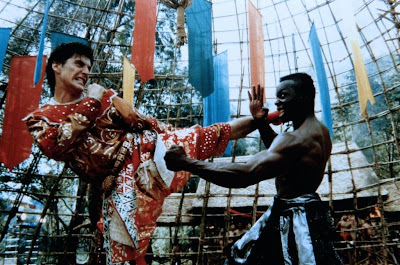
Loren Avedon and Billy Blanks face off in 1991's King of the Kickboxers.
Loren Avedon and Billy Blanks in 1991's KING OF THE KICKBOXERS.

Fist of B-List: Your fight with Billy in KotKB made use of platforms of differing heights surrounded by water, and the climax with Keith, Mark Russo, and Rion Hunter in Blood Brothers involved scaffolding. What were some of the challenges to you as a fighter in engaging with those unique physical environments?
Loren: I'm not a fan of heights, and in KotKB, when I walked the final fight set with the fight choreographer and the director, I noticed that below each platform were real sharpened bamboo sticks. So I said calmly, "can you please make those prop sticks?" Because if anyone -- crew, cast, extras -- happen to slip off the platform, they or I'd be killed. Hellooooooo!

Thank God, I had a great co-star in Billy Blanks, an exceptionally gifted athlete, a gentleman and one of the most humble yet powerful and fast men I have ever known. He/we made it work. I remember him saying to me in the beginning of production, "this is your movie, you're the star and I want to make this film great," and he did. He was one of the best and still is. The challenge for me was keeping up with one of the greatest champions on earth, 7-time world karate champion, Billy Blanks. He made me better, and so did Keith Cooke. I remember we would train together in the hall of the hotel, or in whatever space we could find. When you train with athletes that are more gifted than you are, it makes you better, it bumps up your ability. What you thought you couldn't do, you just do. Then, you get scared and realize what could have happened later and wonder how you did it.

Honestly, the challenges were -- as an athlete, and as a martial artist -- mind over matter, maintaining an even keel, and developing the mental toughness needed to overcome any obstacle. You can't let anything affect your concentration, and covering your ass, that was the challenge, more than as a fighter. The fighting was what I loved. In KotKB, fighting over mosquito and parasite infested klong water with sharpened bamboo pungee sticks below, barefoot, dripping with sweat, 99 degrees with 99 percent humidity, with a mask on, fighting with a sword and then with other apparatus -- took two weeks, six days a week, 12 to 14 hours a day -- let me just say, is truly an example of "what doesn't kill you makes you stronger."
 
In Blood Brothers, with the paint scaffold and again -- 130-degree heat in the summer in Florida, 30 feet off the ground on two 10-inch wide boards that were not secure -- I saw my life flash before my eyes many times. By the third day, I was used to it, and was swinging around like a monkey. The worst thing that happened was when the cameraman 30 feet above me shooting down dropped a metal focus puller, and it hit me in the solar plexus and knocked the wind out of me. After all that, at least he didn't drop the camera on me, that would have left a mark. All good stuff, and no whining allowed. [laughs]

Loren Avedon and Greg Douglass have a mild disagreement in 1992's FIGHTING SPIRIT.

Fist of B-List: Can personal or professional tension with a co-star enhance a fight scene, or hinder your ability to work on it together effectively?
Loren: Tension or disagreements on set with a co-star makes things much harder for everybody on the film to work together effectively. Attitude spreads, if you're already in a miserable situation because of the conditions and you have an actor whining, or anyone for that matter, it affects everyone. We all have our bad days, but when you're part of a team you act professionally and have respect for the job you are doing. You cannot let anything distract you. We are all human, but when the cameras roll, it’s all business. Also, people remember a person’s attitude under stress, and they will talk. So, if you want to work, you put your issues aside and do the job well, because at the end of the day it’s you up there on screen forever for all to see and the camera doesn't lie.

Fist of B-List: Speaking specifically to action filmmaking, how does the American film set compare to those you’ve encountered internationally?
Loren: Well, it’s the conditions, crew, cast and budget usually that are the difference. Most films are cast in the U.S. and go abroad. When you're working under S.A.G. rules you have more amenities and of course protection. Overseas or out of the U.S., you can be worked harder, in less than optimum conditions, with less safety provisions, so you have to "cover your ass" and make sure that you vet all the people and things that can affect your well-being, safety, comfort, and ability to do the best job you can. Out of the U.S., I've had to put my foot down many times because of safety issues, not being paid on time, etc., but by the same token, sometimes you are able to do more things that would be a no-no on a set in the U.S.

Fist of B-List: It seems like starring in a Filipino film was something of a right of passage for American action actors, from Leo Fong to Karen Shepard and Jerry Trimble. Fighting Spirit is one of your lesser known films, yet contains a number of excellent fight scenes. How did you get involved with that production and what was that experience like?
Loren: That was fun, and we did it all with little or no budget, choreographed on the fly. When I got there, we re-wrote the script (I had never even read the script) and made more sense of it. The stunt coordinator that also did the choreography was one of Jackie Chan’s team and we got on well. The Philippines has some great talent and English is spoken by almost everyone, so it makes it easier to work. I was offered that role through my buddy Jacob Bressler in L.A., the producer wanted me to be the star, so we made a deal over coffee at the Sunset Hyatt and a week later I was on a plane to PI.

Fist of B-List: For the most part, you’ve been cast as the hero but have also played the villain in films like Operation Golden Phoenix and Tiger Claws III. Which is more fun for you as an actor?
Loren: Both are fun, but playing the villain gives you so much more room to be creative. As we have seen, good guys have been getting more and more close to the bad guys in what is OK. The difference is, of course, the hero has a moral code and cannot cross certain lines. What makes it fun to play a great villain is the freedom to create a moral code and choices that belong to that character specifically. A great villain doesn't think he is doing anything wrong at all, he believes he has the right to do whatever he wants for whatever reason. For an actor that is heaven.

Fist of B-List: Which has been your favorite character to play?
Loren: My favorite good guy character was Frank Stevens in The Silent Force, and my favorite bad guy character was playing Stryker Goodenough in Tiger Claws III. That was a blast.

Loren Avedon as Frank Stevens in 1998's THE SILENT FORCE.

Fist of B-List: You did a guest spot for In Living Color in 1991 and performed in a scene with Damon Wayans. Your King of the Kickboxers co-star Billy Blanks had a small but memorable part in The Last Boy Scout, also starring Wayans. Were these two castings related in any way or just a happy coincidence?
Loren: My part in In Living Color came after King as did Billy's part in Last Boy Scout. Purely coincidence.

Fist of B-List: Of the action stars during your peak era, with whom would you have liked to work, but never had the chance to?
Loren: I would have like to work more with the Chinese -- with Sammo Hung, Jackie Chan, Michelle Yeoh -- and in Hollywood with some of my idols like Clint Eastwood, for example.

Fist of B-List: Were there any Western martial arts actors with whom you would have liked to work? (ex. Jeff Wincott, Gary Daniels, Richard Norton, Mark Dacascos, etc.)
Loren: All you have mentioned I would have loved to work with. Jeff is by far the best actor of all of us. [laughs]

Fist of B-List: Either in your martial arts training or as a result of a gaffe during the filming of a fight scene: who's the hardest hitter/kicker you've ever encountered?
Loren: Can't really say, but in training it would be JJ Perry. On film, Billy Blanks -- I saw stars a few times when he kicked me. Funny, the most painful kick was the one in KotKB where he drop/axe kicks me in the back, and he hit the lung point between the shoulder blade and spine -- no padding -- and I saw stars and couldn't breathe, but I finished the shot. When the director yelled “cut,” I had to sit down for a few minutes right there on the spot. Billy was concerned and I said to him, "don't hold back,” and he said "but, I am," and we laughed. I said, "well, then keep holding back, but let me have it." He laughed and we carried on. I have so much respect for Billy, he kept our movie poster in his dojo for years. I wonder if it’s still there somewhere in his place in Agoura [California]. I haven't spoken to him in years, but I can tell you that if I did see Billy, he would stop what he was doing, come over and we would shake hands, bro hug and smile. I remember one time coming by his school in Sherman Oaks and I had just missed him, and he ran down to the parking lot to catch me so he could say hello. He's a bad ass, but he has a lot of class, he is a man of honor, and a true martial artist. As my mother taught me, "only the truly great are humble," and she is right.

Loren Avedon and David Michael Sterling in 1990's NO RETREAT, NO SURRENDER 3.

Fist of B-List: American martial arts films from the 1980s and 1990s are known somewhat for the predominance of Otomix gear and Zubaz pants. What's been your most regrettable wardrobe choice from your films? Does anything stand out that made your fight scenes particularly uncomfortable to perform?
Loren: Mitch Bobrow of Otomix always gave me swag to wear, and in the 80's that was the bomb, and those baggy Otomix pants... much easier to move.

Those costumes in KotKB were tough. We had to be sewn into them practically every day. Wearing the light green striped polo shirt, with green pants in NRNS3 going into the karate school was interesting. I think I went to the director and asked him if Will [Avedon’s character] “had a feminine side" with the wardrobe choices they made. If you notice, I always tried to wear long sleeved shirts and pants, so I could wear pads. Then wearing pads constantly was nasty because every day they'd be soaked dirty and bloody, so I'd air 'em out at night and get ready for the next day. I remember asking wardrobe to sew in a diamond shape piece of extra denim in the crotch of the jeans that I did the split kick with in the bar in NRNS3, because I couldn't do the split with standard jeans. If you notice on your gi pants, in the crotch area, is a diamond shaped piece of material. That's what allows you to kick without nutting yourself every time.

Funny anecdote about Mitch Bobrow at Otomix: he would always say that he beat "Superfoot" Bill Wallace back in the point fighting tourney days, and he had some pics of him and Bill in action that he showed me. When I would see Bill and say "you know, Mitch says he beat you back in the day at the internationals," Bill would say to me: "tell Mitch, I don't recall him beating me, and you tell Mitch any time he wants to refresh his memory, he can lace up his gloves and we can go round and round." If you've ever met Bill, who, by the way used to use me as his demo dummy at class -- he'd comb my hair in front of the whole advanced class, with his toes, to demo his famous hook kick and of course, his balance and strength, then, of course, his body jab side kick just above the belt, et al., fun stuff -- and seen those wild eyes, yikes. I used to make him chase me around the mat with his bad knee, cause I was younger and faster, and tag him with little stuff, and pray. Then, usually he'd cut me off and light me up with that jab, right hand and left hook to the head or body, and as a finisher slide up and try and stick his heel through my head! Thank heaven, as I said, I was younger and faster than him (at that time, he was 45, I was 20). Lucky for me!


Fist of B-List: Much appreciated, Loren! Take care.
Loren: A pleasure.

***
I'd like to thank Loren again for his time, and encourage readers and fans who want to hear more of his thoughts on the film industry and his career to check out the audio interviews below:

With The Gentlemen's Guide to Midnite Cinema & Karl Brezdin at ggtmc.libsyn.com
With Super Marcey and John Hamilton at supermarcey.com.


7.25.2011

Operation Golden Phoenix (1994)

PLOT: A security expert transporting a rare medallion is violently betrayed by his partner and set up to take the fall for the theft of this and other Middle Eastern treasures. Looks pretty dire, but it’s nothing that a clever disguise of a hat and moustache can’t fix.

Director: Jalal Merhi
Writers: J. Stephen Maunder
Cast: Jalal Merhi, Loren Avedon, James Hong, Karen Sheperd, Gary Foo


PLOT THICKENER:
Depending on where your interests lie, Operation Golden Phoenix is either a preparedness exercise conducted in California with special attention given to emergency events like earthquakes and terrorist attacks, or Jalal Merhi’s 1994 directorial debut. In either case, you’re dealing with a potentially disastrous scenario.

Merhi plays Marc Assante, a private security expert charged with escorting a recently unearthed bounty of rare and ancient Middle Eastern artifacts. His partner is Ivan Jones (Avedon), an affable kickboxer with a competitive streak (surprise!) The film opens with the two partners embraced in an intense arm wrestling match before Jones gets a call from Mr. Chang (Hong), a greedy criminal mastermind. Based on the cryptic tone of their conversation, there’s no guesswork about their intentions.


Later that night, Assante and Jones are driving a van full of shiny knick-knacks when they find their first checkpoint blocked off by a group of cars. After mostly failing to ram through it, Assante leaves the vehicle and starts shooting dudes and squinting a lot. A group of fake cops appear on the scene and before Assante is knocked out for resisting arrest, he sees Ivan gunned down. When he regains consciousness, the van has been blown to bits, the treasure is gone, and he’s under arrest.

As Assante spends the next several hours getting grilled by cops about the missing artifacts and beating up other inmates in his holding cell, Mr. Chang and Jones are celebrating their incredible coup. The crown jewel of the haul is a rare medallion which, when combined with its counterpart, shows the way to an even greater stash of loot in Lebanon. It doesn’t take long for a phone call to ruin their high spirits, however. Mr. Chang lambastes his partner in crime for leaving Assante to the cops instead of leaving him for dead. Only seconds after being denied bail, their patsy outmuscled his captors and fled into the crowded and eerily polite Toronto landscape.


Just after he escapes police custody and needs to flee the country, Assante happens to have a girlfriend who works as a wig (and mustache) master at a location theater production company. A little too convenient, but in a career full of bad turtlenecks, ponytails, and banana hammocks, it leads to the silliest look Merhi has ever sported: a gray moustache, a big mop of salt-and-pepper hair, and a fedora. Had he simply rolled with it for the rest of the movie, this could have been a pantheon film. Did I get a screen capture of this amazing get-up? Alas, I did not, for you must experience it for yourself (i.e. I can’t currently do screenshots for VHS titles).

As the principals leave Toronto and the focus switches to the pursuit of treasures and vengeance in Beirut, we begin to understand the purpose of this film: it’s a tourism commercial. Footage of the country's exciting car rallies, ancient landmarks, and bikini-clad beach-goers paints it as a popular destination for world travelers in search of exotic luxury. While it’s an obvious love letter to Merhi’s home country, it's also a giant middle finger to the audience. The story introduces characters of no consequence, Assante behaves in completely illogical ways, flaky double-crosses commence, and the action escalates in frequency, if not quality.


As one might expect from a movie in the Film One catalog, the action is hit or miss depending on who’s involved. The inciting incident where Assante is set up is notable for the heavy usage of slo-mo, squibs, and even a rare and vaunted vansplosion. All good signs. During that same scene, however, the stunt driving is done by a middle-aged man in a baseball cap. Loren Avedon was not that man. This lack of effort is redeemed by a scene later on in the film where Ivan Jones fights off a group of surprisingly well-conditioned archaeologists, one of whom challenges him briefly in a rare shovel fight. The scene ends rather hilariously as a man screams after getting kicked off a high wall, but only falls about three feet to the ground. We get the requisite close-up of his crumpled body anyways.

The climactic fight scene between Avedon and Merhi might actually be the latter’s best screen fight ever. That’s not saying a lot, but Avedon sells his offense admirably and throws some decent kicks as well. The fight is less about the choreography than the environment though; they do battle at a sprawling temple complex in what I believe to be the Great Court of Baalbek which houses some of the best-preserved ruins of the Roman period. Even if the editing isn’t so hot (it isn’t), the shots for this scene are composed really well and it’s rare that we see structures of this size and scale photographed this nicely for a martial arts b-movie. In that sense, it’s unique and legitimately interesting from a visual standpoint.


Following a string of popular lead hero roles, this marks the very first lead villain role for Loren Avedon. Despite not having much to work with on the page, he does a fairly good job with the Ivan Jones character. Perhaps because he lacks the brawny physical stature to play a more menacing bad guy -- Matthias and Bolo come to mind -- Avedon brings conniving and sleazy qualities to the role and they fit the character to a T. The film’s opening arm-wrestling scene sets up the rivalry between Ivan and Jalal, and the former’s reluctance to actually kill his partner despite numerous opportunities suggests competitive advantage more than cold-hearted malice as his initial motivation. His misdeeds from that point only escalate in treachery, so it was a decent character development to watch unfold. Mild, but it was there.

On the flipside, I can only guess that Karen Sheperd just really wanted to go to Beirut for a few weeks of fun in the sun. She’s not given a whole lot to do here and her character, the sister of a princess who owns another medallion, felt like a late addition to the story. She does have a fight near the back-end of the film, so it’s made to feel important, but it has none of the visual impact granted to the Merhi-Avedon battle and it didn’t appear that her opponent was a trained martial artist. Certainly not one of her better roles.

The film’s shaky ambitions on “epic-ness” is best encapsulated by the trailer and its uniquely awful voice-over. I won’t embed it here but I’d invite you to check it out on YouTube and behold the incredible amounts of random SAT words and cliches apparently strung together during the throes of a peyote binge. If, by some unholy miracle, the nonsensical priest from For Hire and the guy who wrote this voice-over copy met and collaborated, the output would tear a wormhole in the cosmic fabric of this world that would consume and destroy all meaning in the English language. Books would burst into flames. People would be forced to communicate through a crude Morse code of grunts and drool. It’d be worse than Sarah Palin and George W. Bush trying to answer Google interview questions.

VERDICT:
Some things in life are consistently obvious. The sky is blue, water is wet, and Jalal Merhi stars in vanity projects and surrounds himself with more talented actors and martial artists. As evidenced by his Lebanese descent and the choice to shoot a good portion of the film in Beirut, Operation Golden Phoenix was obviously a labor of love. To Merhi’s credit, the footage of his homeland is composed fairly well. Dramatically, he isn’t completely atrocious here -- though he comes pretty close -- and the film as a whole is much more ambitious than his usual work. Overall though, it struggles to find any real rhythm or momentum, and the action isn’t done well enough to elevate it above below-average action film fodder. For Merhi, Avedon, and Sheperd completists only.

AVAILABILITY:
At this time, VHS only. And for you serious film freaks out there, Laserdisc.

3 / 7

7.19.2011

L.A. Streetfighters (1985)

PLOT: Rival teenage gangs of martial arts street toughs rumble over territory and bragging rights. When one gang tries to go legitimate as a private security team, and one gang member starts dating the sister of a rival gang member, and someone steals drug money, and another guy comes from a broken home, things get really convoluted. And awesome.

Director: Woo-sang Park
Writer: Ji-Woon Hong, Jaime Mendoza-Nava
Cast: Jun Chong, Phillip Rhee, James Lew, Bill Wallace, Loren Avedon
 

PLOT THICKENER:
Bear Republic Brewery’s Racer 5 might be my favorite IPA of all time. You sudsy connoisseurs are probably chuckling at my naivety on the subject, but I had it for the first time recently and gave it immediate and favorable judgement. Taste is like that, so is smell: in analyzing the respective properties, you usually know immediately whether you like something or not. Movies are more slippery. The 1985 Woo-sang Park film L.A. Streetfighters is one that often popped up when researching the filmographies of Loren Avedon, James Lew, and Phillip Rhee. Digging deeper into some random reviews, I found a lot of “so bad it’s good!” reactions and added it to my Netflix queue. I watched it. I probably shrugged. I moved on.

It was added as a “midnight movie” selection to last year’s edition of the New York Asian Film Festival and due to time restrictions, I failed to attend. With fresh eyes, I just revisited the film last week and have concluded this: in terms of cinematic gut reactions, 2009 Karl Brezdin’s guts don’t know shit. This movie is incredible.


Phillip Rhee stars as Tony, a charismatic and likeable high school student. The only problem? He’s the new guy in town and doesn’t look quite tough enough to not be fucked with. Part of it is his affable demeanor but most of it is that he wears the same gray argyle sweater to school every day. (Unless it’s a Members Only jacket, wearing the same clothes on consecutive days is not a cool thing to do.) As a result, the school’s bully, Chan (Lew) and his gang of thugs target Tony for a beatdown, unless he can pay the fee: five dollars. Luckily, the rebellious Young (Chong) sticks up for Tony and challenges Chan to a duel under the cover of night. While his ample mustache might suggest he stayed back a few years, Young is a tough customer and has the leather jacket, black fingerless gloves, and occasional flowy scarf to prove it.

The bo staff is the weapon of choice for the rumble between Chan and Young, and it’s a legitimately well-choreographed fight scene that puts over Young’s skills very effectively. He dominates the contest and Chan’s gang goes scurrying. A casual observer to the proceedings notices that Young is a formidable physical specimen capable of quickly disarming his opponent and immediately offers him a wad of cash to work as private security. We then get the first of several WTF moments, as Young grips the cash in hand, turns his head toward the camera, and begins laughing maniacally before it abruptly cuts to the next scene. Incredible.


Like Chan, Young has a gang of super-tough friends, and also like Chan, he comes from a single-parent household. During a rotating cascade of poorly-lit, ineptly performed, and terribly dubbed scenes of melodrama, Young laments his place in America and his mother’s rampant alcoholism. Will she ever accept him or be a real mother to him? The dilemma frustrates him to no end and he constantly vents to Tony, but his friend seems to think that he should simply concentrate on school, the one thing he can control. Like Bill Gates before him, Young is all “fuck school, I gots to get PAID” and continues to bust heads during the gang’s adventures in private security and random parking garage rumbles.


As Young and friends rush fist-first into the alluring world of working the door at Mexican restaurants and dance clubs, Tony catches the eye of the adoring Lily (King) and they begin to date. Despite their innocent puppy love, this is a highly combustible situation because Lily is Chan’s sister. She attempts to explain away her brother’s dickheaded behavior as the result of their mother abandoning the family. The honesty between them and their mutual love for ice cream only fortifies their romantic bonds, and it seems as if Young is growing resentful. As the gang’s caretaker who took Tony in as a friend, it troubles him to see his friend happy with the sister of his arch-rival. This manifests itself in an awkward scene where Young drives around looking for sex workers for Tony, and mistakes non-sex workers for actual sex workers as Tony shifts nervously in his seat all the while.

There are so many more scenes just like this, none of which can be adequately described in the written word as a means of capturing the same random and off-beat spirit that an actual viewing could. By the time Young steals a drug dealer’s money and the gang is stalked by Bill “Superfoot” Wallace and a samurai-hitman fights a gang member in what looks like an expressionistic art gallery, your head will be spinning with the pure fun of it all. Though, for all the goofiness and technical gaffes, the ending to this movie is bleak as all-fuck which made me love it all that much more.


The action overall is quite good when you can actually see what’s transpiring. While the terrible attention to lighting hurts at times, the choreography is mostly crisp, the movement is framed well, and the editing isn’t overdone. More than the technical components though, the roster of fighters helps these scenes succeed. Rhee, Chong, and Lew are all legitimate taekwondo masters and the inclusion of karate and kickboxing champion Bill Wallace was a cool way to bridge the 1970s and early 80s output of the Chuck Norris era, and the burgeoning talent and work of the 1980s Los Angeles taekwondo scene. I didn’t spot him fighting, but Loren Avedon -- a TKD practitioner -- makes a brief appearance as one of Lew’s buddies. Mark Hicks, who cries over a birthday cake here, has a long history of Hollywood stunt work, just appeared in the action blockbuster Fast Five, and achieved unfortunate Internet fame as Afro Ninja. Also deserving special mention is Danny Gibson, who appears as the leader of the Spikes gang and has one of the most unique looks in a film loaded with questionable fashion sense. You haven’t lived until you’ve seen a mustachioed man in a belly shirt yelling “YOU'RE DEAD MEAT MOTHERFUCKER! DON'T FUCK WITH... THE SPIKES!”


VERDICT:
The terrible lighting. The dubbed dialogue. The fingerless black leather gloves. The VHS artwork that looks like it belongs on the cover of some obscure side-scrolling Data East beat-em-up for the NES. You get all of this and more in the highly enjoyable gang violence romp that is L.A. Streetfighters. While it will never win points on polish or artistic achievement, the film is legitimately historic for other reasons. It’s a cinematic flashpoint for some of the biggest figures in the American martial arts b-movie scene. Phillip Rhee went on to head up the infamous Best of the Best franchise. James Lew would become one of the most prolific stunt performers in Hollywood. Loren Avedon played prominent heroes and villains for the next 20 years. While Chong never achieved the same longevity cinematically, this is his most consistently entertaining piece of work and a legit midnight movie gem. Highly recommended.

AVAILABILITY:
Amazon, EBay, YouTube. Currently in Save Hell on Netflix.

6.5 / 7

7.11.2011

When B-List Goes Hollywood: Ten Random Appearances by Martial Arts Actors in Mainstream Media

Partly because I have too much free time, but mostly because of this blog (which was more or less born out of having too much free time), I often pore over the filmographies of martial arts b-movie actors to track down films to review. Because of the niche skill-sets that these actors brandish, many of them have done little else but martial arts or action film and television work. Thus, most of my searches reveal no surprises. Every once in a while, though, I’ll stumble across an acting credit that’s unique because of the role the actor is playing, or because of the visibility of the production itself. When an actor jumps from PM Entertainment to an 8 PM prime-time television slot, it’s cause for celebration. Plenty of martial arts b-movie actors have logged screen-time in mainstream film and television productions. Some of these I knew and some were new to me, but compiled below is a short and random list of some of my favorite examples.


Dale Jacoby - Step by Step (1994)
The owner of one of the most incredible early-90s pompadours in action film history had few roles where he didn’t play a raging, Zabka-lite douchebag. So it’s no great surprise that he visited familiar territory for this supporting television role on a 1994 episode of TGIF’s saccharine stepfamily sitcom, Step by Step. Jacoby plays an evil and arrogant karate coach opposite Sasha Mitchell’s Zen-surfer martial artist, Cody, who’s trying to instill the fighting spirit in his nerdy step-cousin. The casting is a little less random when you consider that Jacoby and Mitchell worked together on Albert Pyun’s Kickboxer sequel in 1991.


Chuck Jeffreys - Pootie Tang (2001)
It was a bit of an inevitability that the Shaolin Wushu expert and Bloodmoon co-star would appear on this list. His list of various stunt credits in Hollywood productions is impressive and he’s one of the most prolific American fight coordinators of the modern film age. In a two-decade career that’s found him training Wesley Snipes for sword battles in the Blade films and choreographing fights in Spider-Man, perhaps none of his cinematic contributions were more memorable than selling the awesome power of the belt in the 2001 cult comedy Pootie Tang. Sine your pitty on the runny kine!


Jeff Wincott - The Wire (2008)
Jeff Wincott is probably the most “actorly” of the bunch on this list and has had a ton of mainstream film and television roles (The Invasion and last year’s Unstoppable among them). After combing through his credits, I’d narrowed it down to his role as an undercover "homeless" cop on HBO's The Wire, or his part in 2008’s Lake City, where he plays a menacing drug kingpin who slaps the shit out of Dave Matthews and strangles his balls, striking a mighty blow for jam-band haters everywhere. Odd as that might be, it gets no bigger than the series finale of the best television show in history.


Cynthia Rothrock - Eye for an Eye (1996)
More than any other part listed here, Rothrock’s role as a self-defense instructor is so short and fleeting that you will literally miss it if you blink. A Sally Field revenge thriller is pretty much the last place you’d expect to find a martial arts actor of Rothrock’s stature, but you can’t blame her for taking a break from the Herculean task of carrying Jalal Merhi to watchable movies.


Matthias Hues, Big Top Pee Wee (1988)
If you can find something more random than Matthias Hues running around in a lion-tamer’s outfit acting alongside Kris Kristofferson in this oft-reviled sequel to Pee-Wee’s Big Adventure, I will give you my last can of Crystal Pepsi.


Loren Avedon - In Living Color (1991)
What makes Avedon’s cameo on the legendary Fox sketch-comedy show interesting is not that he plays a redneck cowboy, or even that he has to sell a terrible stomach punch by Damon Wayans (playing hilarious vocabulary manipulator Oswald Bates). Rather, this guest role came shortly after what arguably remains his best and most popular film, The King of the Kickboxers. Avedon shouldn’t feel too bad though; Wayans pilfered his co-star for a role in another mainstream production on this list.


Don “The Dragon” Wilson - Stealing Harvard (2002)
I was ready to put The Dragon down for his role as the gang leader who sets his day-glo goons on Robin in Joel Schumacher’s Batman Forever. However, because the skull make-up turned him nearly unrecognizable, and “gang leader” isn’t quite so strange a part for a martial arts actor, I had to give top prize to his even more random role in the 2002 comedy Stealing Harvard. Wilson counted the late Chris Penn as one of his best friends in Hollywood and plays one of the Reservoir Dogs star’s drug gang thugs. Seeing him as a neon nightmare in a superhero summer blockbuster is pretty cool, but the viewing experience of the Bloodfist star trying to kick Tom Green’s head off while adorned in not much more than flip-flops and boxer shorts is fucking surreal.


Gary Daniels - The Expendables (2010)
There’s nothing unusual about a prolific DTV action star playing a supporting role in a Hollywood action production. What makes Gary Daniels’s role in the 2010 action throwback The Expendables unique is that Sylvester Stallone had literally dozens of actors he could have used to stoke the flames of action b-film nostalgia. While most of Gary’s action scenes in the film fell victim to choppy editing and the dreaded Hollywood shaky-cam, his inclusion suggests that Stallone has at least some admiration for DTV action of the 1990s. This might portend more interesting casting choices when you consider the rumor that Stallone’s vision for the sequel will be a “love letter to martial arts.” GASP.


Billy Blanks - The Last Boy Scout (1991)
I apologize to those of you who have been unable to fit this film into your viewing schedule at some point during the last 20 years, but Blanks might have the most impactful screen time of all the parts listed here. As star football running-back Billy Cole, Blanks has the joy of doing a bunch of PCP at halftime during a game and then shooting several would-be tacklers with a firearm during a breakaway running route in the film’s opening. After scoring a touchdown, he blows his brains out. Umm... Tae-Bo anyone?


Jerry Trimble - Heat (1995)
In his film debut, champion kickboxer Jerry Trimble played a mulleted drug dealer who gets his face burned with a space heater in The King of the Kickboxers. Five years later, he had a speaking part in some marginally successful crime drama directed by Michael Mann, and starring actors like Robert De Niro, Al Pacino, Val Kilmer, Jon Voight, and Natalie Portman. Um...so...yeah. Jerry Trimble rules this list forever.


I know that I’ve missed a ton of equally deserving parts, so feel free to contribute your favorites in the comments below.
Related Posts Plugin for WordPress, Blogger...