Showing posts with label nrns. Show all posts

9.17.2012

Enter the Interview: Loren Avedon


Between romantic melodramas, comedies, and wuxia epics, Hong Kong's booming film industry was producing a couple hundred films per year during the 1980s and early 1990s. However, the region's cinematic bread and butter -- and its most popular genre internationally -- was the action film. Due in part to the transcendent popularity of Bruce Lee and the recent homegrown success of The Karate Kid, the U.S. market was primed for more kicks to its cinematic face.

Seasonal Film Corporation rose to the challenge and produced a total of seven films which combined Hong Kong action direction and fight choreography with American actors, locations, and sensibilities. Perhaps no other action star is as irrevocably linked to this series of films as Loren Avedon, who played the lead roles in No Retreat, No Surrender 2, No Retreat, No Surrender 3: Blood Brothers, and King of the Kickboxers. They remain three of the best American martial arts films ever produced. Armed with tremendous speed and technique during fight scenes, and humor and confidence in his line delivery, Avedon took the ball and ran with it.

Following his work with Seasonal, Avedon acted on television shows such as Baywatch and Martial Law, performed fight choreography for Tiger Claws III, and co-wrote the story for 1998's Deadly Ransom, a film in which he also starred. When I approached him for our very first interview this past August, he was extremely gracious with his time and candid in his responses. We touched upon everything from the ingredients of good fight choreography, to playing the villain, to his respect for co-star Billy Blanks.

Fist of B-List: Within about a week’s time, you went from selling used cars to starring in an action feature (NRNS2). Based on the changes in the industry you’ve observed during your career, would it be easier or more difficult for a twenty-something Loren Avedon to break through in today’s film scene?
Loren: I do have a one in a million story, and I know I am truly lucky to have been in the right place at the right time. But you create your own luck sometimes, when preparation meets opportunity as is in my case. In 2012, with technology allowing anyone with a digital video camera and computer to make their own film, or at least a great demo, the industry has changed completely for an up and comer. However, the fact is that it takes a lot of time, money and people to make a good commercial film for the international market. There is so much competition it depends on what your goals are as the twenty-something aspiring action star. I'd say it’s easier to break through these days because of technology, but at the same time more difficult because others can do the same thing, so it all boils down to talent, desire, timing and hard work.


Fist of B-List: The art of Tae Kwon Do has a major emphasis on kicks. Who -- perhaps other than Hwang Jang Lee -- are some of your favorite kickers to watch on film?
Loren: Of today’s films, I like Tony Jaa, Scott Adkins, and Donnie Yen and of course the great stunt men who you see flying in and getting kicked out, who will never get any credit. Of course, my all-time favorite is the original, the one and only, Bruce Lee.

Fist of B-List: As a martial artist, what do you believe is the most important element in a successful fight scene? The creativity and execution of the choreography? Shooting angles? Editing?
Loren: All are important, but it really depends on your fight director/choreographer and the talent in front of the camera as the key ingredient. If you have excellent athlete/martial artist/stunt actor fighters, you will have a great fight scene, but then again if you don't have a great director of photography, or 2nd unit director that knows how to shoot it, you are screwed. But if the fight is great because of the talent in front of the lens, and enough coverage, the editor can sometimes fix all. What I loved about working with the Chinese is they had the editor on set working with the director, fight choreographer, actors and DP. So the editor knew exactly what the director wanted and was able to suggest some shots to the director, and/or take notes on what takes he liked the best of those that were printed. The editor went to all the dailies -- remember we used to shoot on 35mm film -- to check the shots. If they were no good or something was missing, we'd shoot what was needed. We had no video playback, so a lot of the shots, the fight choreographer and director would put eye to lens themselves when we rolled camera, to make sure the shot was framed the way they wanted it. These days you have so many effects, software, and CG to help make things work, but you have to have all the ingredients and lots of coverage, or you'll end up with rubbish. It’s the little things: the reactions, the power powder, the sound, the acting while fighting…all can make things more powerful. It’s a team effort.

Fist of B-List: You’ve mentioned your fights with Billy Blanks (King of the Kickboxers) and Matthias Hues (NRNS2) as personal favorites. Which fight scene (or scenes) from your film work proved the most difficult for you individually?
Loren: Don't forget the end fight in Blood Brothers with Keith Vitali... that was a killer too. All of them were difficult really. If I wasn't sick from the food, I was sore, bruised, injured and in pain, boiling hot or freezing cold weather, and tired as hell.
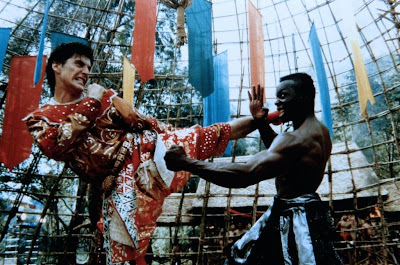
Loren Avedon and Billy Blanks face off in 1991's King of the Kickboxers.
Loren Avedon and Billy Blanks in 1991's KING OF THE KICKBOXERS.

Fist of B-List: Your fight with Billy in KotKB made use of platforms of differing heights surrounded by water, and the climax with Keith, Mark Russo, and Rion Hunter in Blood Brothers involved scaffolding. What were some of the challenges to you as a fighter in engaging with those unique physical environments?
Loren: I'm not a fan of heights, and in KotKB, when I walked the final fight set with the fight choreographer and the director, I noticed that below each platform were real sharpened bamboo sticks. So I said calmly, "can you please make those prop sticks?" Because if anyone -- crew, cast, extras -- happen to slip off the platform, they or I'd be killed. Hellooooooo!

Thank God, I had a great co-star in Billy Blanks, an exceptionally gifted athlete, a gentleman and one of the most humble yet powerful and fast men I have ever known. He/we made it work. I remember him saying to me in the beginning of production, "this is your movie, you're the star and I want to make this film great," and he did. He was one of the best and still is. The challenge for me was keeping up with one of the greatest champions on earth, 7-time world karate champion, Billy Blanks. He made me better, and so did Keith Cooke. I remember we would train together in the hall of the hotel, or in whatever space we could find. When you train with athletes that are more gifted than you are, it makes you better, it bumps up your ability. What you thought you couldn't do, you just do. Then, you get scared and realize what could have happened later and wonder how you did it.

Honestly, the challenges were -- as an athlete, and as a martial artist -- mind over matter, maintaining an even keel, and developing the mental toughness needed to overcome any obstacle. You can't let anything affect your concentration, and covering your ass, that was the challenge, more than as a fighter. The fighting was what I loved. In KotKB, fighting over mosquito and parasite infested klong water with sharpened bamboo pungee sticks below, barefoot, dripping with sweat, 99 degrees with 99 percent humidity, with a mask on, fighting with a sword and then with other apparatus -- took two weeks, six days a week, 12 to 14 hours a day -- let me just say, is truly an example of "what doesn't kill you makes you stronger."
 
In Blood Brothers, with the paint scaffold and again -- 130-degree heat in the summer in Florida, 30 feet off the ground on two 10-inch wide boards that were not secure -- I saw my life flash before my eyes many times. By the third day, I was used to it, and was swinging around like a monkey. The worst thing that happened was when the cameraman 30 feet above me shooting down dropped a metal focus puller, and it hit me in the solar plexus and knocked the wind out of me. After all that, at least he didn't drop the camera on me, that would have left a mark. All good stuff, and no whining allowed. [laughs]

Loren Avedon and Greg Douglass have a mild disagreement in 1992's FIGHTING SPIRIT.

Fist of B-List: Can personal or professional tension with a co-star enhance a fight scene, or hinder your ability to work on it together effectively?
Loren: Tension or disagreements on set with a co-star makes things much harder for everybody on the film to work together effectively. Attitude spreads, if you're already in a miserable situation because of the conditions and you have an actor whining, or anyone for that matter, it affects everyone. We all have our bad days, but when you're part of a team you act professionally and have respect for the job you are doing. You cannot let anything distract you. We are all human, but when the cameras roll, it’s all business. Also, people remember a person’s attitude under stress, and they will talk. So, if you want to work, you put your issues aside and do the job well, because at the end of the day it’s you up there on screen forever for all to see and the camera doesn't lie.

Fist of B-List: Speaking specifically to action filmmaking, how does the American film set compare to those you’ve encountered internationally?
Loren: Well, it’s the conditions, crew, cast and budget usually that are the difference. Most films are cast in the U.S. and go abroad. When you're working under S.A.G. rules you have more amenities and of course protection. Overseas or out of the U.S., you can be worked harder, in less than optimum conditions, with less safety provisions, so you have to "cover your ass" and make sure that you vet all the people and things that can affect your well-being, safety, comfort, and ability to do the best job you can. Out of the U.S., I've had to put my foot down many times because of safety issues, not being paid on time, etc., but by the same token, sometimes you are able to do more things that would be a no-no on a set in the U.S.

Fist of B-List: It seems like starring in a Filipino film was something of a right of passage for American action actors, from Leo Fong to Karen Shepard and Jerry Trimble. Fighting Spirit is one of your lesser known films, yet contains a number of excellent fight scenes. How did you get involved with that production and what was that experience like?
Loren: That was fun, and we did it all with little or no budget, choreographed on the fly. When I got there, we re-wrote the script (I had never even read the script) and made more sense of it. The stunt coordinator that also did the choreography was one of Jackie Chan’s team and we got on well. The Philippines has some great talent and English is spoken by almost everyone, so it makes it easier to work. I was offered that role through my buddy Jacob Bressler in L.A., the producer wanted me to be the star, so we made a deal over coffee at the Sunset Hyatt and a week later I was on a plane to PI.

Fist of B-List: For the most part, you’ve been cast as the hero but have also played the villain in films like Operation Golden Phoenix and Tiger Claws III. Which is more fun for you as an actor?
Loren: Both are fun, but playing the villain gives you so much more room to be creative. As we have seen, good guys have been getting more and more close to the bad guys in what is OK. The difference is, of course, the hero has a moral code and cannot cross certain lines. What makes it fun to play a great villain is the freedom to create a moral code and choices that belong to that character specifically. A great villain doesn't think he is doing anything wrong at all, he believes he has the right to do whatever he wants for whatever reason. For an actor that is heaven.

Fist of B-List: Which has been your favorite character to play?
Loren: My favorite good guy character was Frank Stevens in The Silent Force, and my favorite bad guy character was playing Stryker Goodenough in Tiger Claws III. That was a blast.

Loren Avedon as Frank Stevens in 1998's THE SILENT FORCE.

Fist of B-List: You did a guest spot for In Living Color in 1991 and performed in a scene with Damon Wayans. Your King of the Kickboxers co-star Billy Blanks had a small but memorable part in The Last Boy Scout, also starring Wayans. Were these two castings related in any way or just a happy coincidence?
Loren: My part in In Living Color came after King as did Billy's part in Last Boy Scout. Purely coincidence.

Fist of B-List: Of the action stars during your peak era, with whom would you have liked to work, but never had the chance to?
Loren: I would have like to work more with the Chinese -- with Sammo Hung, Jackie Chan, Michelle Yeoh -- and in Hollywood with some of my idols like Clint Eastwood, for example.

Fist of B-List: Were there any Western martial arts actors with whom you would have liked to work? (ex. Jeff Wincott, Gary Daniels, Richard Norton, Mark Dacascos, etc.)
Loren: All you have mentioned I would have loved to work with. Jeff is by far the best actor of all of us. [laughs]

Fist of B-List: Either in your martial arts training or as a result of a gaffe during the filming of a fight scene: who's the hardest hitter/kicker you've ever encountered?
Loren: Can't really say, but in training it would be JJ Perry. On film, Billy Blanks -- I saw stars a few times when he kicked me. Funny, the most painful kick was the one in KotKB where he drop/axe kicks me in the back, and he hit the lung point between the shoulder blade and spine -- no padding -- and I saw stars and couldn't breathe, but I finished the shot. When the director yelled “cut,” I had to sit down for a few minutes right there on the spot. Billy was concerned and I said to him, "don't hold back,” and he said "but, I am," and we laughed. I said, "well, then keep holding back, but let me have it." He laughed and we carried on. I have so much respect for Billy, he kept our movie poster in his dojo for years. I wonder if it’s still there somewhere in his place in Agoura [California]. I haven't spoken to him in years, but I can tell you that if I did see Billy, he would stop what he was doing, come over and we would shake hands, bro hug and smile. I remember one time coming by his school in Sherman Oaks and I had just missed him, and he ran down to the parking lot to catch me so he could say hello. He's a bad ass, but he has a lot of class, he is a man of honor, and a true martial artist. As my mother taught me, "only the truly great are humble," and she is right.

Loren Avedon and David Michael Sterling in 1990's NO RETREAT, NO SURRENDER 3.

Fist of B-List: American martial arts films from the 1980s and 1990s are known somewhat for the predominance of Otomix gear and Zubaz pants. What's been your most regrettable wardrobe choice from your films? Does anything stand out that made your fight scenes particularly uncomfortable to perform?
Loren: Mitch Bobrow of Otomix always gave me swag to wear, and in the 80's that was the bomb, and those baggy Otomix pants... much easier to move.

Those costumes in KotKB were tough. We had to be sewn into them practically every day. Wearing the light green striped polo shirt, with green pants in NRNS3 going into the karate school was interesting. I think I went to the director and asked him if Will [Avedon’s character] “had a feminine side" with the wardrobe choices they made. If you notice, I always tried to wear long sleeved shirts and pants, so I could wear pads. Then wearing pads constantly was nasty because every day they'd be soaked dirty and bloody, so I'd air 'em out at night and get ready for the next day. I remember asking wardrobe to sew in a diamond shape piece of extra denim in the crotch of the jeans that I did the split kick with in the bar in NRNS3, because I couldn't do the split with standard jeans. If you notice on your gi pants, in the crotch area, is a diamond shaped piece of material. That's what allows you to kick without nutting yourself every time.

Funny anecdote about Mitch Bobrow at Otomix: he would always say that he beat "Superfoot" Bill Wallace back in the point fighting tourney days, and he had some pics of him and Bill in action that he showed me. When I would see Bill and say "you know, Mitch says he beat you back in the day at the internationals," Bill would say to me: "tell Mitch, I don't recall him beating me, and you tell Mitch any time he wants to refresh his memory, he can lace up his gloves and we can go round and round." If you've ever met Bill, who, by the way used to use me as his demo dummy at class -- he'd comb my hair in front of the whole advanced class, with his toes, to demo his famous hook kick and of course, his balance and strength, then, of course, his body jab side kick just above the belt, et al., fun stuff -- and seen those wild eyes, yikes. I used to make him chase me around the mat with his bad knee, cause I was younger and faster, and tag him with little stuff, and pray. Then, usually he'd cut me off and light me up with that jab, right hand and left hook to the head or body, and as a finisher slide up and try and stick his heel through my head! Thank heaven, as I said, I was younger and faster than him (at that time, he was 45, I was 20). Lucky for me!


Fist of B-List: Much appreciated, Loren! Take care.
Loren: A pleasure.

***
I'd like to thank Loren again for his time, and encourage readers and fans who want to hear more of his thoughts on the film industry and his career to check out the audio interviews below:

With The Gentlemen's Guide to Midnite Cinema & Karl Brezdin at ggtmc.libsyn.com
With Super Marcey and John Hamilton at supermarcey.com.


7.28.2012

Fist of Further Reading: Guest Post on Rupert Pupkin Speaks


I was recently awakened from my sleepy, drunken summer stupor by our good friend Rupert Pupkin, who runs the excellent film blog, Rupert Pupkin Speaks and also contributes to The Gentlemen's Guide to Midnite Cinema. For the better part of the last two months, he's been featuring the cream of the crop in "bad" movie selections from a bevy of film writing heavyweights. Despite my recent disappearance from the Internet, Rupert was kind enough to let me join a very talented and insightful group of writers to contribute to this series. Be sure to check out the whole damn thing.

Don't worry your pretty head, because new shit on Fist of B-List is coming soon. Until then, check out the guest post on a smattering of no good, very bad movies on the most excellent Rupert Pupkin Speaks!

9.27.2010

No Retreat, No Surrender 3 (1990)

PLOT:
Two brothers are forced to put aside a bitter sibling rivalry when their father is murdered by a lethal terrorist syndicate. While each follows a different path towards an inevitable showdown with the villains, they both manage to fuck up in equally illogical ways.

Director: Lucas Lowe
Screenwriter: Keith W. Strandberg
Cast: Loren Avedon, Keith Vitali, Rion Hunter, Joseph Campanella, Wanda Acuna, David Michael Sterling


PLOT THICKENER:
When the day comes to finally retire, I plan to walk away from the world of business fully cashed out with no loose ends. I will grow a wily and unkempt beard, live somewhere deep in the woods, and brew my own mindbending moonshine. Retirement is a difficult proposition that, for some, leads to part-time consulting or inspires an outright refusal to quit. For those involved with the dangerous world of covert operations, the concept doesn't appear to exist at all. The field is a dangerous web of death and deceit that never fully relinquishes its grip from those who partake in the madness.


John Alexander (character actor Joseph Campanella) is a classic case of the former workhorse who can't walk away from the game. He keeps former agency cohorts as social buddies and his son, Casey, is deeply entrenched in the "Company" work as a hard-kicking field agent. Portrayed by Keith Vitali, Casey leads a quiet and modest life. A carousel of smoking hot ladies, a shiny performance sportscar, and designer suits at least two sizes too big are a few of the luxuries in which he indulges on a regular basis. Having followed in his father's footsteps, he is regularly lauded by John and his CIA friends as he consistently farts excellence as a model of covert greatness. Very quietly, of course.

Not all of the senior Alexander's clandestine genetics were passed onto his progeny though. His younger son, Will (Avedon), stands firmly against everything his family's employers do. He refers to the lot of them as babykillers and has no qualms about rocking a swanky Soviet-inspired denim jacket at his dad's birthday party with scores of CIA employees in attendance. He ain't no fairy peacenik, though, working as a karate instructor by day and ... probably something in retail at night. Despite his ambiguous academic credentials, he lives the grimy undergraduate lifestyle. His wheels: a used VW Bug. His meals: loaves of bread and cola in the can.


Will is not unlike many younger siblings in feeling overlooked and underestimated due to his older brother's stature. The source of the tension between the two brothers isn't explicitly stated but we can infer it has something to do with Will being a stubborn nancy and Casey being a cocky prick. Papa Alexander recognizes his sons' unique differences but wants nothing more than for the three of them to spend quality time together. His silly insistence on investigating a terrorist syndicate sorta puts an end to that aspiration, because they show up to his pad after his birthday party and give him a surprise present: a Rolex! Ha, kidding. It was actually a violent and bloody death.


Leading the group of assholes-for-hire is the devious Franco, played by Rion Hunter. A veteran of action television with few film roles under his belt, Hunter more than holds his own in this early and rare role as main scoundrel. Other than a trademark deathblow, the cardinal rule for any martial-arts villain is a striking visual presence and Franco nails it in every conceivable way. His signature look forgoes sinister for stylish -- an incredible bottle-blonde mullet paired with a rotation of turtlenecks and stylish jackets with the sleeves rolled up to the elbow. It's Miami Vice meets Dynamic Dudes on Don-Niam-as-Stingray Boulevard and it works to great effect. His deathblow is equally memorable: a bird-sized metal dart launched with expert precision.

Not only does Franco walk the walk, but he talks the talk with several great lines. He remarks at one point that singed human flesh smells much like roast pork, and while this is a precarious assertion at best (I'm in Camp Grilled Chicken) he sounds confident saying it. Throughout the film, Franco's line delivery boils over with a relaxed arrogance befitting a terrorist leader who has consistently evaded capture and while neither he nor his minions appear to have any concrete political beliefs, they definitely have demands. We never learn what those demands are, but Franco insists that they definitely have some. Furthermore, the group is based in that most fiendish cesspool of terrorist strongholds -- Florida. My guess is their list of demands begins with a better hangout in a different state.

Most of the second act follows Will's adventures in planning and executing an infiltration of Franco's gang and Casey's attempts to prevent his brother from getting in over his head. Throughout this process of push-and-pull, the energy normally reserved for hating each other is instead used to fuel their collective thirst to avenge their father's death. I'm not sure what that says about the human condition, but I can say that the net result is a lot of fucking kung-fu. Among the three entries in the NRNS franchise, Blood Brothers has the slickest action choreography and highest volume of hand-to-hand fight sequences by far. That being the case, it also has the highest amount of visible stunt doubles and the most ridiculously convuluted plot in the series. And while I sincerely feel the original NRNS set the bar for technically inept American martial arts filmmaking, the boom mic here makes so many onscreen appearances it should have been given an acting credit. I'm not sure how director Lucas Lo managed to overlook this most egregious set of errors but I have a feeling he was too busy shooting technically proficient fight scenes with visible stunt doubles.


The film culminates with several kidnappings, an incredible showdown inside an airplane hangar, and even a cameo by a certain 41st President of the United States. Also: buckets of drool, sweat, blood, and slo-mo, though I'm not sure if it's possible to place slo-mo in actual buckets. While Avedon is rock solid across all categories and Vitali's fighting skill barely manages to overshadow his atrocious (though amusing) acting, Rion Hunter shines through as the overall prime performer of the bunch. His Franco is the best creation of villainy in the NRNS franchise and while that might not seem like the biggest compliment, he's one of the best villains in the history of Western martial-arts film, though that doesn't seem like such high praise either.

VERDICT:
Marked by great fight choreography and even better late 80s hair and fashion sense, Blood Brothers is the final official sequel in the No Retreat, No Surrender trilogy. This subtitle is fitting since the central characters -- much like the three films in the NRNS franchise -- have nothing in common with one another but find a way to work together because of the bond to the person who created them. As mentioned, it has the best fight scenes of the three films and much of it is on par with most Hong Kong output during the same era. It's a shame Rion Hunter didn't do more villainous film roles, but given the sheer volume of random black belts who won tournaments getting film roles during this period, it's no great surprise he didn't have long-term traction in the genre. A certain must-see, if not a must-own.

7 / 7

8.19.2010

No Retreat, No Surrender 2 (1987)


PLOT:
American kickboxer Scott Wylde travels to Thailand to visit an old friend and his college sweetheart. When she gets kidnapped, his vacation sorta goes downhill. With the help of friend Mac Jarvis and a kickboxing helicopter pilot named Terry, he must save his woman from an evil Soviet force based in Cambodia.

Director: Corey Yuen
Screenwriter: Keith W. Strandberg
Cast: Loren Avedon, Max Thayer, Cynthia Rothrock, Matthias Hues, Hwang Jang Lee


PLOT THICKENER:
Romantic love can make you do strange things. It can make you drive eight hours to spend four hours with someone. It can make you cook an elaborate meal, or write thoughtful notes and leave them around the house as surprises. For Scott Wylde (Avedon), love means busting out of police custody, killing 40 people with arrows and bullets, and climbing up a fucking waterfall. As much as you may love your spouse or partner, you will never love anyone as much as Scott Wylde does.

Shortly after arriving in Thailand, he makes a visit to a Muay Thai kickboxing school frequented by his old friend Mac (Thayer). He instead finds a bunch of guys who don’t speak English and a sassy American named Terry (Rothrock), who rocks an Esprit workout shirt almost as hard as she busts heads in the ring. On his way out, Scott drops a snide “your mother” joke which pisses off a Thai fighter and leads to a quick kickboxing scrum. After all, mom jokes are universal and kickboxing is the only logical resolution to such differences of opinion.


After a sweaty day of backpacking, Scott checks into a hotel haunted by the constant moaning of either whores or ghosts. He phones his Asian fiance, Sulin, to arrange the night’s plans and they end up going out for a dinner of fried bugs and tiger balls, dishes she insists he try in order to impress her father.

If the mustachioed man leering at them from afar during dinner wasn’t a bad enough omen, Scott brings Sulin back to room #13 at the hotel. After sex that we can only assume followed the slow-motion removal of their clothing, the couple is attacked in their room by a group of thugs. They carefully wrap Sulin in blankets to prevent damage during transport and two others stay behind to kill loverboy. He counters their blades and poisonous syringes with asskickery and jets over to Sulin’s family’s house to break the news that their daughter has been kidnapped. They have bigger things to worry about though -- they’ve been murdered! The police are suspicious of Scott’s presence at the house and take him into custody. Missing from the crime scene is Sulin’s wealthy father, who watches from behind closed doors as Scott undergoes a very sweaty interrogation back at the station. Roy Horan, who co-wrote the script, makes a cameo here as the American consular who mandates that Scott be deported to Singapore. As you might have guessed, Horan does not fight Bruce Lee in this film.

As protagonists tend to do, Scott escapes police custody the next day (thanks a fucking lot, Roy Horan). He tracks down Mac at a go-go dancing/arm-wrestling bar and to escape the heat of cops and bounty hunters, they head to a low-key restaurant outside the city. For an extra layer of cover, Scott wears a hat with a big floppy brim, perfect for a day of laying by the pool if you’re a girl. A group of bounty hunters are unswayed by this clever disguise and demand that the two come with them or die. Scott schools the baddies with acrobatic strikes and Mac utilizes his bad habits to great effect. He burns one guy’s face with a lit cigar, and wastes precious food by smashing eggs and melons into enemy heads. For his final act, he tosses a cobra at a gunman who Scott recognizes as one of the kidnappers from the night before. During a brief interrogation, they learn Sulin is being held in Cambodia at place called Death Mountain. It’s quite majestic between September and February but the weather’s a bit on the mild side.

At Mac’s warehouse of weaponry (he’s a black-market arms dealer) our heroes load up on enough firepower to fight an army and expel enough exposition to kill a horse. Mac posits that the Soviet-North Vietnamese forces have kidnapped Sulin to exploit her father, who is funding an anti-Khmer Rouge resistance movement. The two embark on their trip early the next day, but not early enough to evade the Thai authorities camped outside. A helicopter arrives just in time to fly them to safety, but the pilot turns out to be Terry, the wise-cracking kickboxer. Apparently, she and Mac have an intense history of sexy feelings and constant bickering. Mac is annoyed by her presence, Terry is frustrated by the assignment, and Scott is again very sweaty from the oppressive Thai humidity.


Shortly after their arrival in Cambodia, they make contact with a local resistance force to whom Mac has sold arms in the past. The colonel agrees to help them locate the Soviet camp, but only after Mac agrees to trade a battle tank for opium. To put this in perspective, it looks a lot like an F-16 worth of psychedelic mushrooms. Without warning, the camp is bombarded with explosives from above. The crew evades certain death by diving into a pond but their prospective guides have been blown to bits. With Plan A firmly in the shitter, they turn to Plan B -- wandering the jungles of Cambodia without the benefit of maps or a compass.

The Soviet camp where Sulin is held captive is run by a brutal general named Yuri, played by Matthias Hues. In a display of cruelty, he challenges an injured prisoner to a fight and dangles the promise of freedom as incentive. After inflicting punishment in the form of internal bleeding, Yuri lets him limp towards the exit for about ten feet before shooting him in the leg and ass. He then throws him into a pit full of crocodiles. While laughing hysterically. Following this comical turn of events, he turns to Sulin and assures her that he won’t harm her. Hmmm.

Meanwhile, our heroic trio is trudging through the jungle without the benefit of sunscreen, insect repellent, or moisture-wicking clothing, because it hadn’t been invented yet. They come upon a riverside camp of Buddhist monks, which reveals their deeply ingrained prejudices about non-Western religions. Mac doesn’t “trust people who don’t eat meat” (true, they don’t). Scott thinks they “sing and shake beads all day” (not entirely true). Terry states that “they’re harmless” (demonstrably false). The “monks” attack them and what follows is a legitimately great fight scene involving some slick rope work and gruesome kills. Though it must be said that for a guy purporting to frequent a Muay Thai gym, Mac doesn’t do an awful lot of kickboxing. After the scrum, Terry tries to start up a motorboat for a getaway but gets captured by a group of Yuri’s rogue military men and is whisked away upriver.


Back at the Ruskie Ranch, Terry is forced to fight Yuri’s second in command, an officer played by the legendary Hwang Jang Lee. After a brief show of skill by both fighters, Yuri steps in and asserts his authority. For reasons I’ll leave undisclosed, he decides that both she and Sulin will be executed by overly elaborate means the next morning. However, Mac and Scott have discovered the camp and set a number of overly elaborate traps, bombs, and self-firing machine guns under the cover of night.

Yuri decides to kick off the morning with an crocodile feeding, with both hostages suspended over the pit with nothing to counterweight them but a pair of sandbags. Terry remains defiant, remarking that Yuri would be a “big hit at the circus” (oddly prescient since Hues played “Oscar the Liontamer” in Big Top Pee-Wee just a year later). Scott and Mac awake to Sulin’s screams as both women are lowered into the pit. Before unleashing their bag of goodies, Scott and Mac share the first on-screen fist bump I can recall and the chaos commences. Bombs send soldiers flying, gunfire splatters the camera lens with blood (in 1987!), and arrows pierce flesh with pinpoint accuracy. And the girls are saved! Sort of.

Scott and Yuri battle hand-to-hand all over the compound in a climax filled with screaming and flag desecration and crocodiles. The fight is gloriously over the top and might be the best of Hues’ career. After the bloodshed and multiple ‘splosions, Scott cryptically speaks, “Let’s get the hell out of here.” Intentional or not, I’d like to think this 1980s martial-arts actioner was dropping some subversive commentary on the military presence of the United States in Southeast Asia with this last bit of dialogue. But I also cracked up at the “Thanks To” credit to Mike Miller at the end of the film, because I pictured the Miami Heat shooting guard:


VERDICT:
While a sequel in name only, there’s something for everyone in No Retreat, No Surrender 2 and it’s probably the best in the series. The kills are plentiful, the action is well-choreographed and well-shot, and there are reasonably good performances from all the principals. What really held it together for me was Thayer’s screen presence; as a real-life military vet and star of several Filipino action/war films of the 1980s, he’s a natural fit and seems very comfortable as the grizzled arms dealer. I’ve seen him comparatively positioned in other reviews as a Han Solo type and I’ll echo that sentiment here as well. In the first of his three-picture run with Seasonal Films, Loren Avedon is damn good; his acting, while raw, still has personality, and his fighting is excellent. Rothrock plays cocky reasonably well despite some grating dialogue, and Hues is good as the heartless Russian monster despite a fairly obvious German accent. You may be able to find this on Youtube in its entirety but action aficionados will want to acquire the readily available import for their collections. Followed by No Retreat, No Surrender 3: Blood Brothers.

7 / 7

Related Posts Plugin for WordPress, Blogger...